
A new “Place de la Bastille”
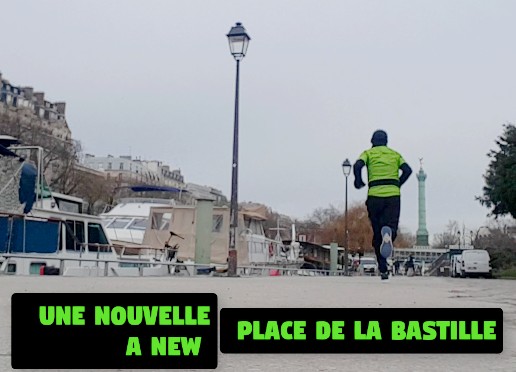
After months of work, pedestrians can “take back” the Bastille and the Bassin de l’Arsenal, which have been pleasantly laid out. No more cars on the basin side, with more trees, historical landmarks on the ground (made by the Manufacture de Sèvres) and direct access to the canal by a 55-step staircase. The quays of the port of the Arsenal have been enlarged for the pleasure of strollers (and runners!). At the foot of the stairs, one can lose one’s gaze under the tunnel of the Canal Saint Martin. Many thanks to Jérôme, Romain and Sarah for your participation 🙂 —- Paris Running Tours: private tours or free outings, stay tuned! See you soon for new themed outings, we are full of ideas to show you around Paris 😀 If you too, you come to Paris, we will be very happy to run with you. Join us and discover Paris with authentic Parisians guides who will take you on the best sight running routes in Paris and who always have tons of secrets to share with you:
Exploring the North-East of Paris with Sarah
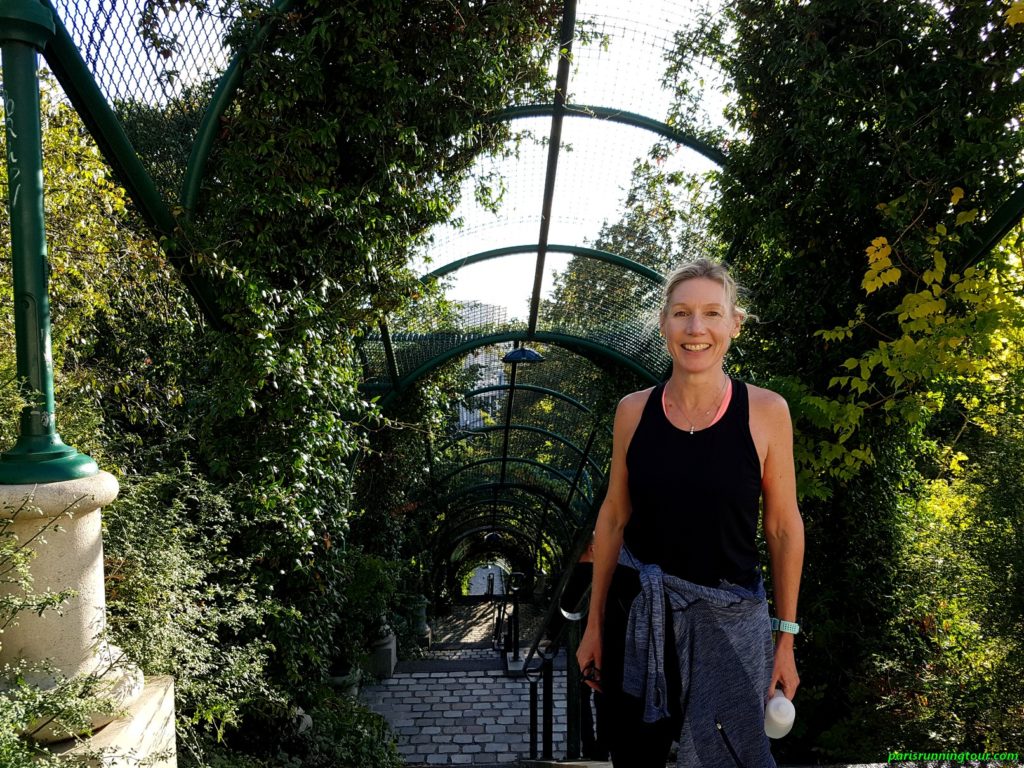
Do you remember Sarah (UK)? We had the great pleasure of meeting Sarah for the eighth time and sharing new places (we always create new routes to discover more of Paris), for example: the eight Paris Running Tours realized with Sarah. We explore all of Paris 😀 Thank you very much Sarah and see you soon for new adventures in Paris! If you too, you come to Paris, we will be very happy to run with you. Join us and discover Paris with authentic Parisians guides who will take you on the best sight running routes in Paris and who always have tons of secrets to share with you:
Come and discover the Parisian Street Art with us
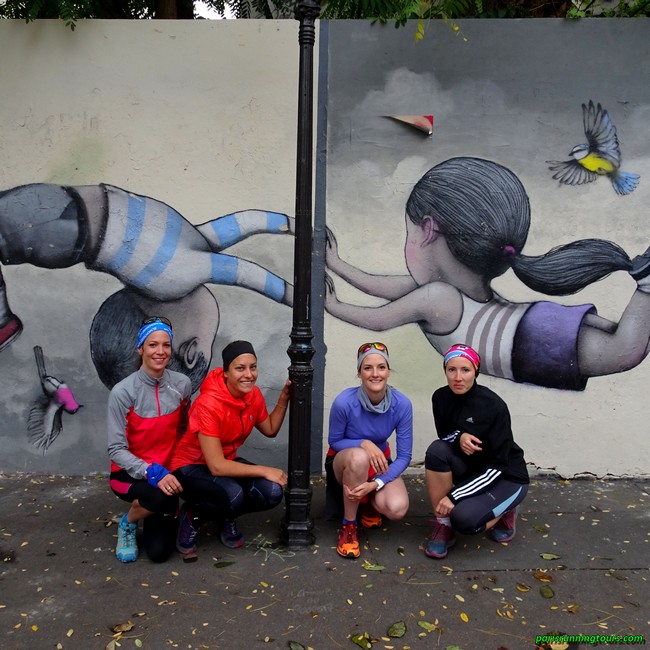
At Paris Running Tours, we love all aspects of Paris and there are many, History, Art, Culture, new trends, street furniture, new events, etc. We like to share all this with our visitors. One of the things we like to introduce you to is the Street Art (or “Street-Art”) that flourishes everywhere in Paris. New works of art regularly appear in the different districts of Paris, as above, with this recent work by Seth in this old district of Paris, Seth who often paints children as here. Thank you to our runners from Switzerland, on this Sunday, October 7, 2018, Christine, Morgane, Marie-Eve and Nathalie! Thank you Christine for introducing us to “the whole team”. We were very happy to meet you again for a tour. Here are some other examples of Parisian “Street Art”: You will certainly remember that for a certain period of time (~2008-2015), the “Pont des Arts” had become the “Love locks bridge”. Find the changes of the Bridge in this article, old article now. Before moving definitively to transparent panels to replace the grids, Paris allowed street artists to cover the bridge with artistic works. We like the one in the following photo which represents the Paris Coat of Arms in an original way: Next Sunday, October 14, 2018, it will be the race of the 20 km de Paris. The theme of this year’s race: “Street Art”! If you too, you come to Paris, we will be very happy to run with you. Join us and discover Paris with authentic Parisians guides who will take you on the best running routes in Paris and who always have tons of secrets to share with you:
In front of the rotunda of La Villette with Felicity
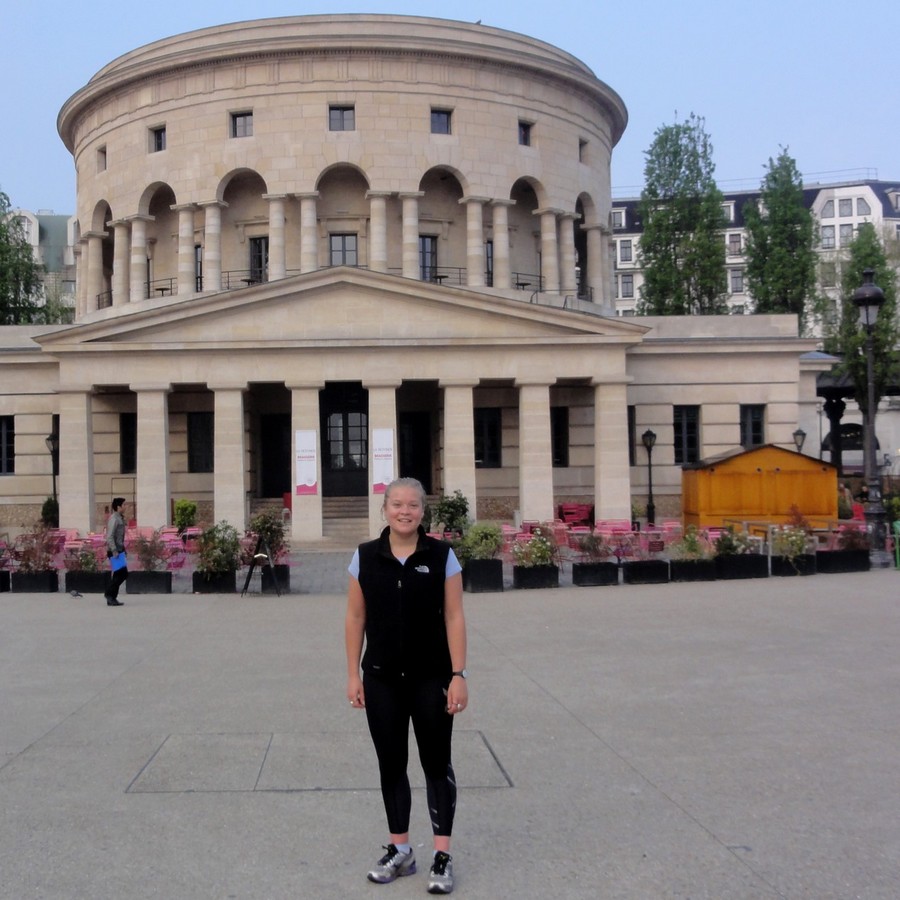
Felicity – Rotunda of la Villette 7:51 AM – Do you remember Felicity from Melbourne, Australia ? (See the post here.) Two years ago, we ran along the river Seine. This time, our route led us to the North East of Paris, since Montmartre up to the Ourcq canal, then to the Saint-Martin canal and to the Grand boulevards. First of all, we followed the former plan of the Wall of the Farmers Generals. Paris grew as an onion, protected successively by various surrounding walls (as for example, Philippe Auguste’s surrounding wall, see the post here). All these walls had a protective function except one: the Wall of the Farmers Generals. The different city walls of Paris The Wall of the Farmers Generals served to collect the tax on all the goods entering Paris (the “Octroi”). Its construction began before the Revolution in 1784, it was destroyed in 1860. At the time, we thus entered Paris by passages, barriers. Most of these barriers contained buildings called “bureaux d’octroi” (“offices of granting”). 61 “bureaux d’octroi” were created by the architect Nicolas Ledoux. There remains of these constructions among which the beautiful rotundas of the Parc Monceau and of the Villette. We can see the Rotunda of the Villette at the beginning of this article. We then followed the Saint-Martin canal, which construction was decided by Napoleon the 1st. Felicity – Saint-Martin Canal A little later, we joined the Grand boulevards and admired the Arc de Triomphe of the Saint-Denis gate, arc created by king Louis XIV, arc dedicated to the consecration of his glory (” Ludovico Magno “!). You will find the history of this Arc de Triomphe and the Grand boulevards in an article of the blog=> here. Felicity – “Porte Saint-Denis” Finally, back to Montmartre, we crossed the Moulin Rouge. Felicity – The “Moulin Rouge” Contrary to the “Moulin de la Galette” (see the picture here), the “Moulin Rouge” was never a real windmill, but from the beginning, a cabaret, this famous cabaret which saw the birth of the “French cancan” and which is always in service. Merci Felicity ! The route of the tour :
By running with Tove and Charlotte on the Ourcq Canal
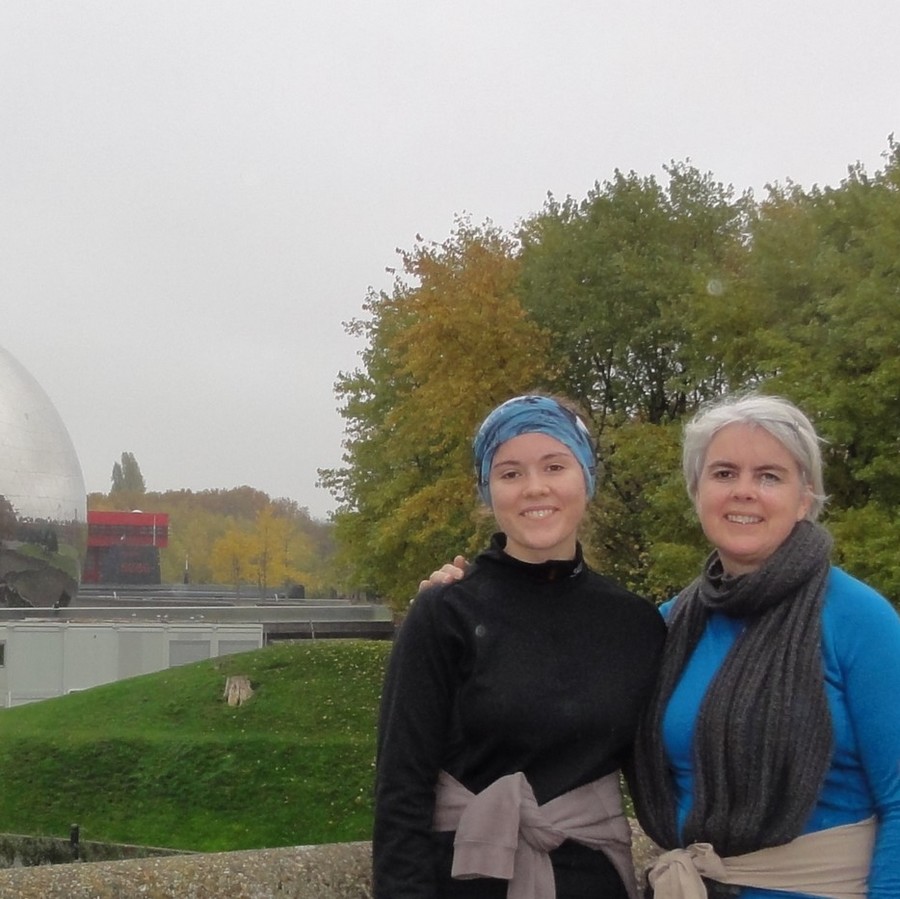
Charlotte and Tove – “City of Sciences and of Industry” – “La Géode” 9:55 AM – Tove lives in Norway; The time of a short stay, Tove came to see her daughter Charlotte who studies in Paris. They know well Paris but wished to discover the Parisian canals. We thus began our visit by running street Lafayette, continued along the Ourcq Canal and the Saint-Martin canal and ended our visit with the “Grand boulevards” and “passages Jouffroy” and “Verdeau”. First amazing discovery, the building at 145, Lafayette street: 145 Lafayette Street Windows, balcony, a door, a roof… A building like any other? No, an artificial building intended to hide a huge air vent of the Parisian subway! Not far, still “rue Lafayette”, a mural painting proposes an original representation of Paris: “Coup de chapeau à Paris” – François Boisrond – 2001 Having left the long Lafayette street, we exceeded the limit of the general farmers’ old wall and the barrier of the Villette with its magnificent rotunda built by Claude Nicolas Ledoux, to find the Ourcq canal. Tove and Charlotte – “Canal de l’Ourcq” – South-West view The construction of the Canal of the Ourcq was decided by Emperor Napoleon Bonaparte in 1802. The Ourcq canal insures a supply of Paris in water by connecting the river Ourcq (more than hundred of kilometers with ten locks). The neighborhoods of the Canal and the district of the Villette were completely renewed from the years 1970-1980, in particular by the destruction of the gigantic slaughterhouses of the Villette in 1974 and by the creation of the “Cité des Sciences” opened in 1986, of the Géode (a huge cinema) opened in 1985 and of the “parc de la Villette“. View of the canal inside Paris from “place Stalingrad” to the “Parc de la Villette” Charlotte and Tove – Ourcq canal – North-East view Having turned back, we ran along a part of the Saint-Martin canal, the other beautiful canal, which joined the Seine. Merci Tove et Charlotte ! The route of the tour :
Running on the canal with Toni
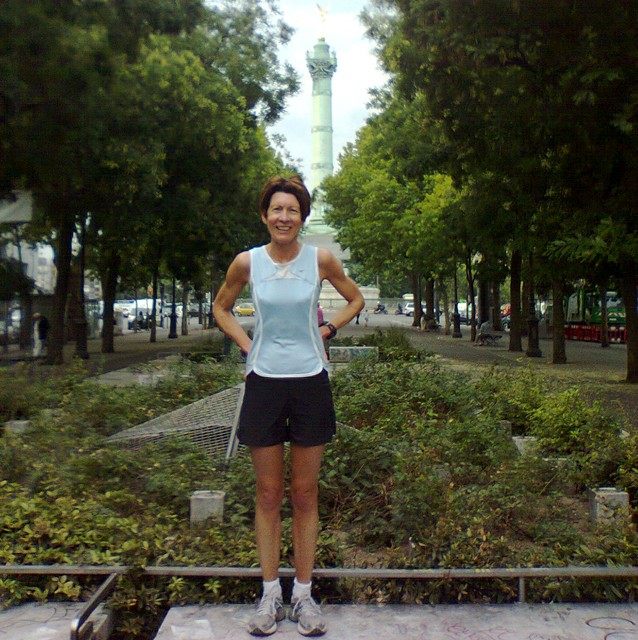
Toni – On the covered canal 7:46 AM – Toni (Adelaïde, Australia) is a runner of very good level. The running had essentially for objective to visit Paris and it is thus with a quiet pace that we crossed the city, in 12 kph… (Quiet pace? Yes, for Toni!). We left the garden of the Luxembourg to discover the east of Paris and notably the covered part of the Saint-Martin canal. In 1802, Napoleon Bonaparte ordered the creation of the canal to improve the supply of Paris in drinking water. Later, between 1860 and 1862, the Baron Hausmann, Prefect of the Seine, within the framework of his big works of improvement of Paris, covered the canal on a big part (the current boulevard Richard Lenoir). As for main avenues and boulevards of Paris, these works also answered the objective to make easier the military interventions. Troops left to repress a rebellion would have been slowed down by an open-air canal, even crossed by bridges! A covered canal, this is better… The open-air canal part (in the upper left label, the 10km of the 10th arrondissement, around the canal) Merci Tony ! The route of the tour :
Along canal Saint-Martin and river Seine with Kristina
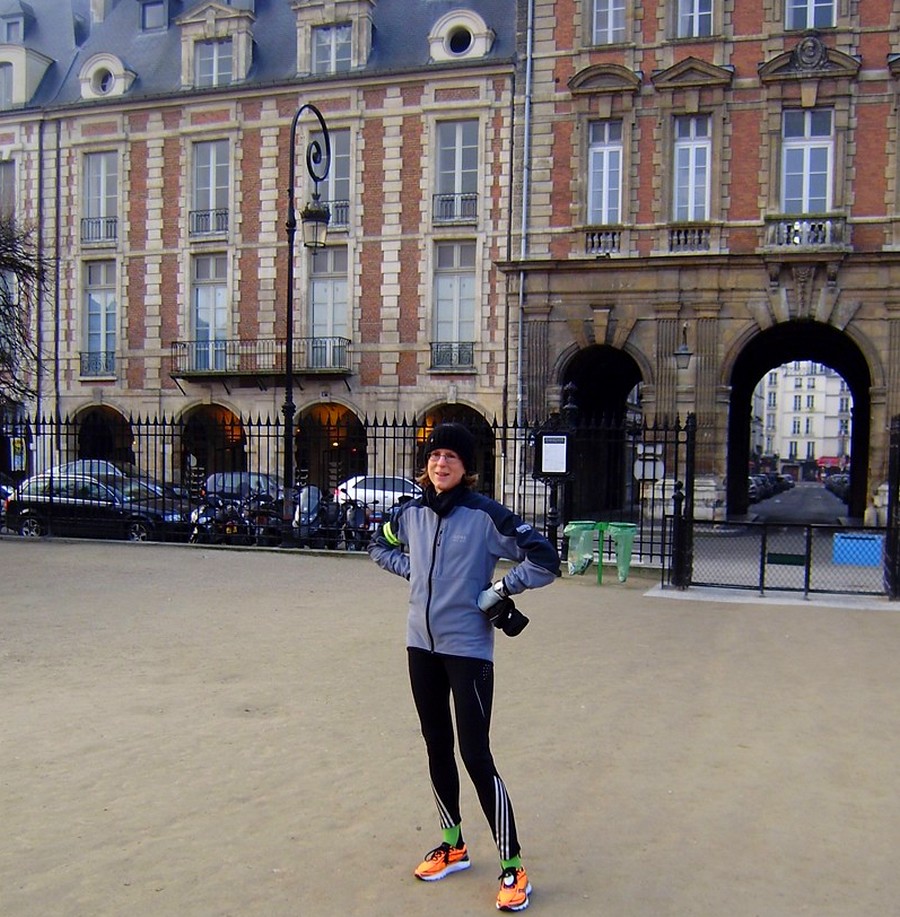
Place des Vosges – Kristina 7:30 AM – Saturday and Monday – Kristina, from Freising (Germany), is a regular runner. As Anne and Niels, she decided to fully enjoy Paris while running, choosing to run twice with Paris Running Tour, Saturday and Monday morning. First tour, a jogging along the canal Saint Martin, following the “Quai de Valmy”, the “Quai de Jemmapes”, going by “la place de La Bastille” and along the Arsenal Marina. Second running tour, a run along the Seine, enjoying the “Ile de la Cité” with Notre Dame, La Sainte Chapelle and La Conciergerie, afterward the left bank, then after admiring the Musee d’Orsay, the right bank and back to the start, through “Les Tuileries” and “Le Louvre”. On our way, La place des Vosges: The king Henri IV created “La place Royale” at the beginning of the 17th century. This squared place was conceived with a rigorous architectural design (same style for each house, arcades and pillars, …) The place inspired many European residential squares. In 1799, when was raised taxes to support the campaigns of the Revolutionary armies, “Les Vosges” was the first department to pay (department in the east of France); Paris thanked “Les Vosges” naming the square “La place des Vosges”. Many famous persons lived there, as Victor Hugo (you can visit his house). Merci Kristina! The routes of the tours (Saturday and Monday ):
Along the Canal with Jannicke in a sunny and cool morning
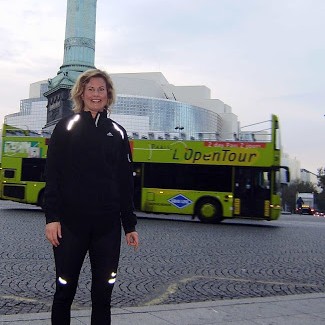
Place de la Bastille – Colonne de Juillet – Jannicke 7:57 AM With Jannicke from Oslo (Norway), we started from “Le Marais” district and went to the canal St-Martin by the “place de la République”, then reached the “place de la Bastille” and the Arsenal Marina, a yachting harbor, with several house barges floating on the quiet water. We enjoyed running in the cold morning (around +3°C, for October, a relatively cold temperature in Paris), went around the “place des Vosges” and then finished along the bank of the river Seine a few meters from the Notre Dame cathedral with a nice rising sun. Merci Jannicke! On our way: On the “Place de la Bastille” stands the “Colonne de Juillet” (the July Column). The monument commemorates the Revolution of 1830 (and not the 1789 one), the “three glorious” days in July 1830 that saw the beggining of the “July Monarchy” of Louis-Philippe (and the fall of Charles X of France) This column, with “Le Génie de la liberté” (The Spirit of Freedom) at the top, is inspired from the Trajana Column in Rome. Another Column in Paris is also inspired from the Roman Column, visible in the centre of the “Place Vendôme”, with this time, dressed as a Roman Emperor, Napoleon at the top! We already talked about the Bastille, see there. The route of the tour: You can display Jannicke’s tour on a bigger map