At the Palais Royal with Ray
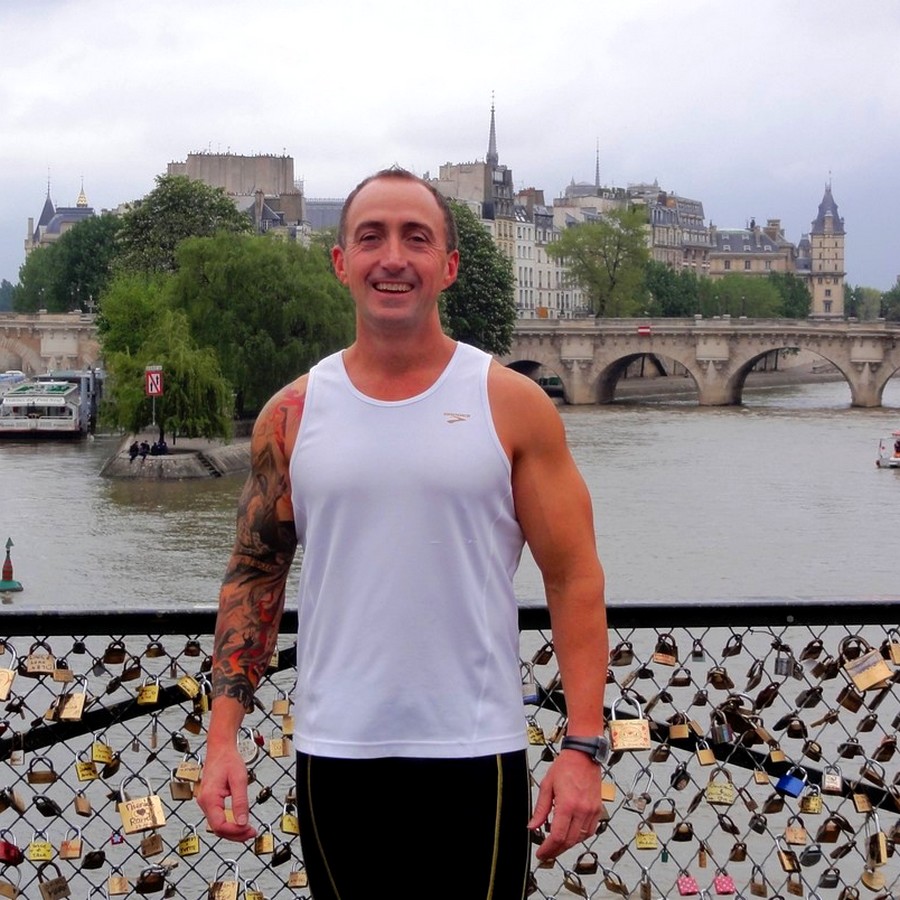
Ray – Pont des Arts 6:48 AM – Ray, who lives near Sydney (Australia), on a business trip to France, took advantage of this Saturday morning to do a visit of Paris by running. Ray is an experienced coach who trains high-level athletes (See Ray’s web site). It is thus with a good pace that we went to discover the city. Having run on the left bank, we crossed the river Seine by the “Ile de la Cité” then joined the Palais Royal (Royal Palace), very quiet in the morning. Ray – Garden of the Palais Royal The Palais Royal was built by Cardinal de Richelieu in 1628. The Palace was then called the Cardinal Palace. After the death of Richelieu, the Regent Anne of Austria settled down there. His sons, king Louis XIV and his brother spent their first years there. The period of “La Fronde” (The sling) where the parliament and the noble persons dispute the royal authority, brought the king Louis XIV outside Paris. The Palace of Versailles was one of its biggest creations outside the capital. Palais Royal and Palais Royal’s garden After the Sling and the departure of young king Louis XIV, the Royal Palace witnessed numerous historic periods, the feasts of the Regency at the beginning of the 18th century for example, the debates of ideas and the start of the Revolution of 1789, then with the 19th century, the world of Cafés, houses of games and of prostitution (games and soliciting were forbidden in the 1830s)… Do you remember of the small cannon of the Palais Royal about which we had spoken here? More recently, in 1986, the Palais Royal exhibited a work of modern Art, “Les Deux plateaux” of the artist Daniel Buren, so called the “Columns of Buren”: Ray – Palais Royal – Columns of Buren These columns aroused an important debate within the population and in the media. The work of Art was nearly demolished. Very recently, as seen at the left of the photo above, quite wooden, a new theater appeared, the “Théâtre de l’Ephémère” (Short-lived Theatre), which replaces temporarily the nice building of “La Comédie Française”, currently being renovated. Merci Ray ! The route of the tour:
Ancient Paris, modern Paris with Beth, Paige and Pamela
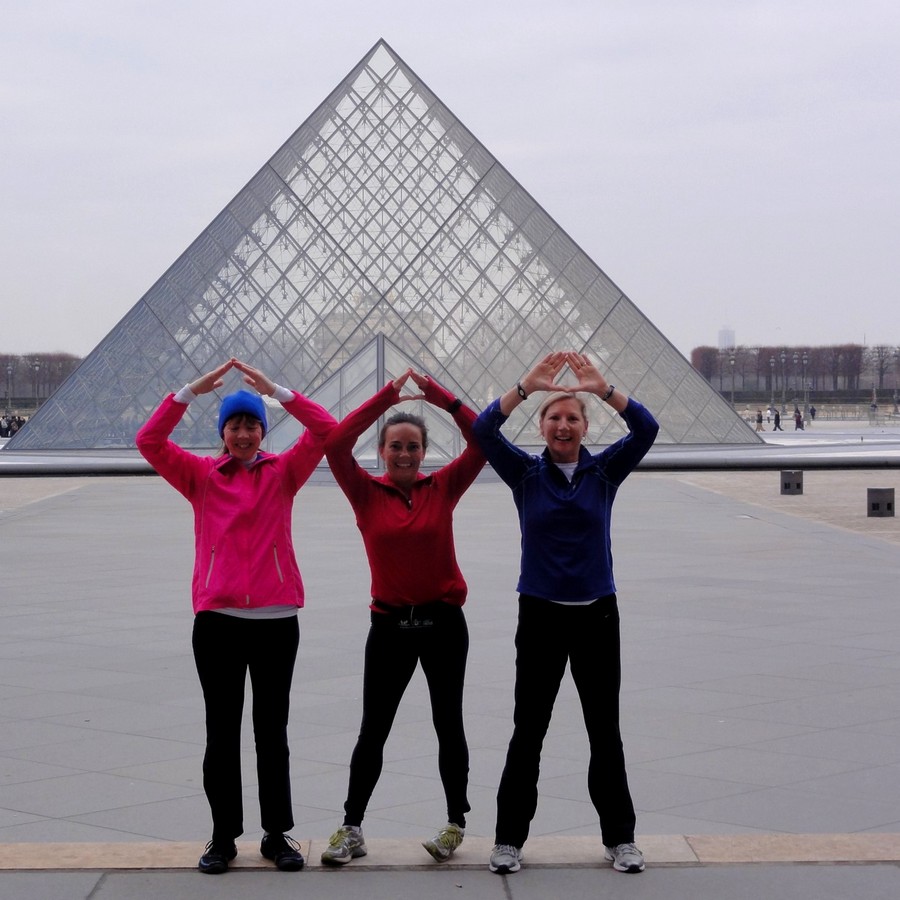
Pamela, Beth, Paige – Bridge of “la Concorde” and “Assemblée Nationale” 8:15 AM – With Beth, Paige and Pamela from North Carolina (USA), we discovered by running the variety of the Parisian landscapes, from the most ancient parts of the city to the most modern Paris: 19th century. We left the “Place de la République” and followed the “boulevard du Temple”, formerly named the “boulevard of the Crime”. This ancient nickname is due to the theaters which populated the boulevard in 19th century, numerous “crimes” were committed but only in the melodramas which occurred there! A place very livened up in the time, remember the beginning of the movie “The children of the paradise” which redraws so well that had to be the Boulevard: 12th century. We then joined “Le Marais” and crossed the most visible part of the surrounding wall of the king Philippe Auguste then admired Notre-Dame. The surrounding wall and the Cathedral which made us return to the end of the 12th century: Wall of Philippe Auguste – Creation 1190 | Cathedral Notre-Dame of Paris – Creation 1163 20th century. After the Middle Ages, it is the end of the 20th century which appeared, at first with the Louvre Pyramid, created by the architect Ieoh Ming Pei in 1989, then with the “Kiosque des Noctambules”, metro entrance (Palais-Royal station) and work of art created in 2000 by the artist Jean-Michel Othoniel: Louvre pyramid – Inauguration 1989 | “Le kiosque des Noctambules” – Installation 2000 Paris always evolves; what will the 21st century give us? Merci Beth, merci Paige, merci Pamela! The route of the tour:
Passing by the Palais Royal with Bill and Emily
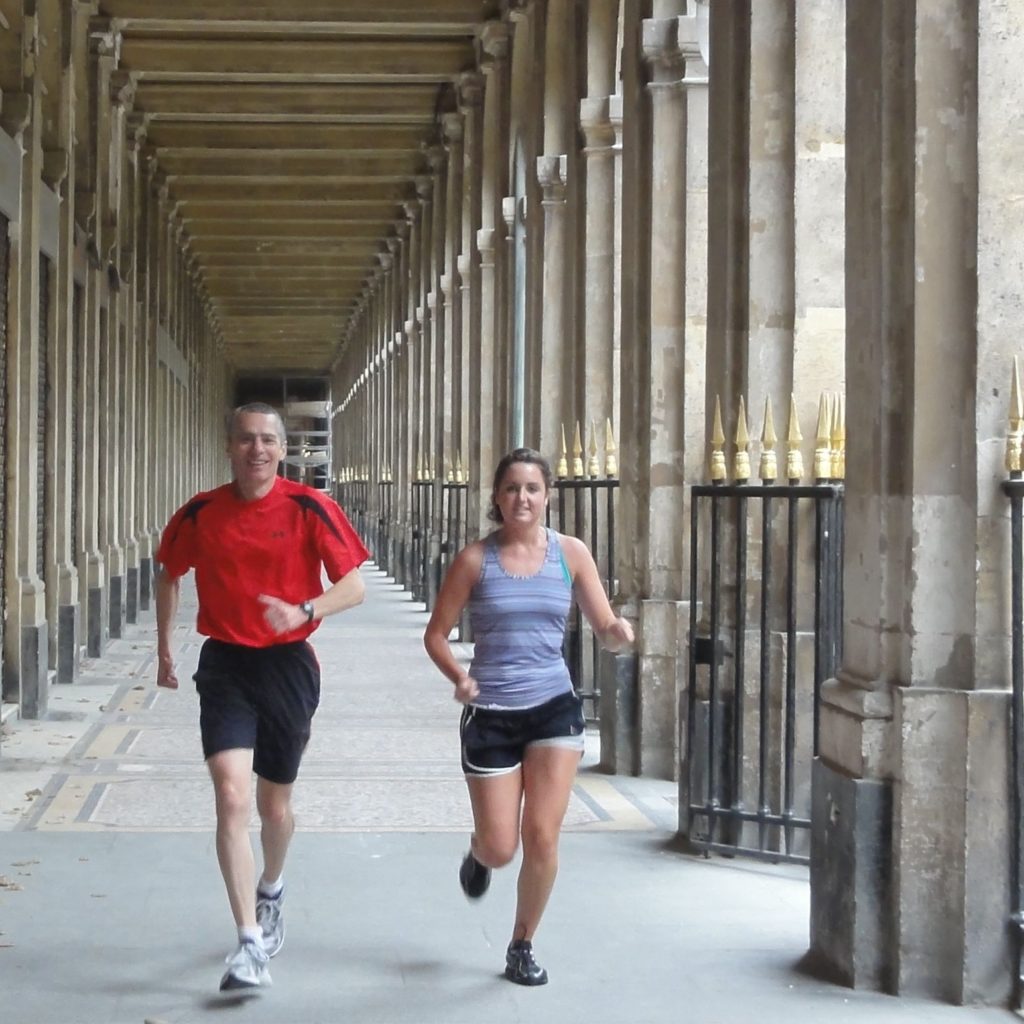
9:03 AM – With Bill and his daughter Emily, from Albany (USA), we explored Paris by drawing two loops around the islands of La Cité and Saint-Louis, right bank then left bank. It is at a good pace, the family of Bill and Emily being very sporting, that we discussed of Paris, the running and the new possibilities of visits, the archeological crypt near Notre Dame, the Sainte-Chapelle and the Conciergerie, the Louvre entering by the Carousel, the Panthéon, the “Jardin des Plantes”, … Passing by the Palais-Royal, we also evoked the small cannon of the garden. It was a watchmaker who, in 1786, installed this small cannon on the meridian of Paris. When it was present, the sun, through a correctly directed magnifying glass, lit the fuse every day at noon. The thunder of the cannon indicated the hour of noon to the neighborhood.Nowadays, the original cannon having been stolen, a copy replaces it. Lit electrically, it thunders every Wednesday at noon, for the biggest enjoyment of the Parisian. If you can, go to see it, otherwise here it is, filmed: Merci Emily! Merci Bill! Merci Alison! The route of the tour :
Classicism and modernity with Karen and Nigel
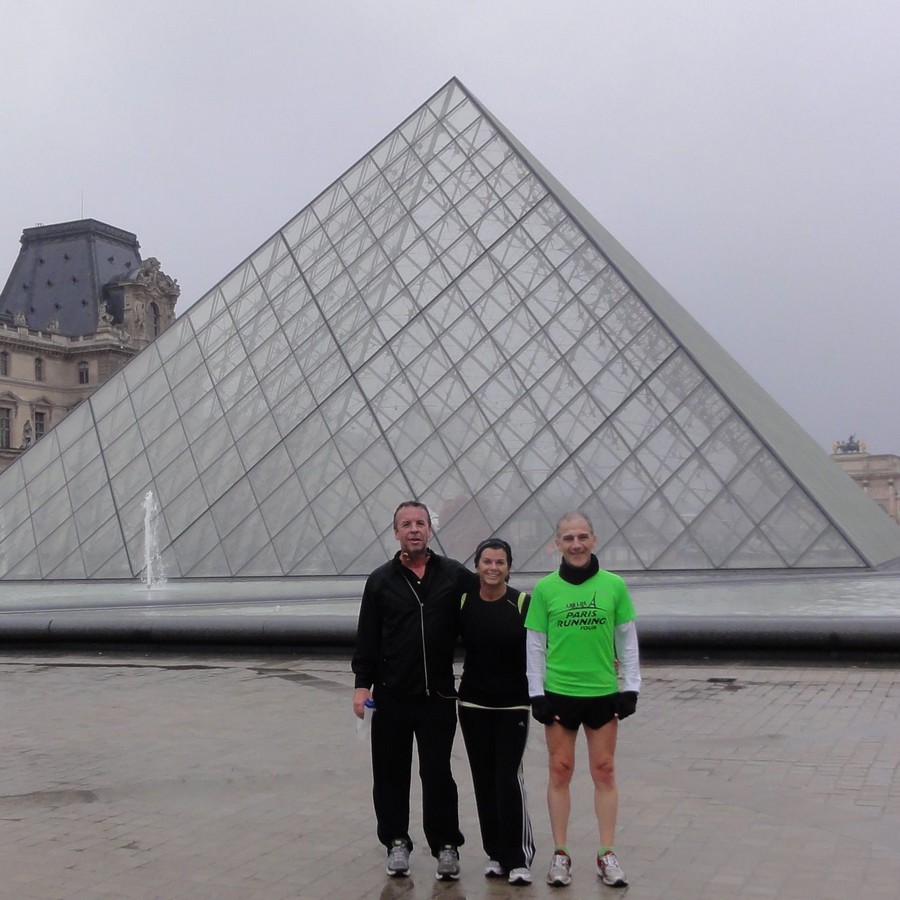
Pyramide du Louvre – Nigel, Karen and Jean-Charles 8:06 AM – With Karen and Nigel from UK, we started from the Opera District to go along the river. Karen and Nigel finished with success the Brighton half-marathon one week ago. We ran at a good pace though, with no consideration for the little rain we had in Paris this morning. The route we took allowed us to notice that many Parisian places share classicism and modernity with harmony. For instance, in the Louvre district, we appreciated how the pyramid of the Louvre was designed to respect the environment of the surrounding classic buildings. Not so far, in the Palais Royal, we saw the Columns of Buren, another example of modern art integrating a classical environment (there was a strong controversy at the time of its creation but, in Paris Running Tour, we like this combination…) Going through a passage in the Louvre to go to the Palais Royal, we had the opportunity to see rooms of the Louvre presenting another mix of modern art and classic art: the temporary exhibition of Tony Cragg, who had juxtaposed his modern sculptures to the classic ones. Merci Karen and Nigel! “Red figure” – Tony Cragg -2008 (on the right 😉 The route of the tour: