
Running doing a spiral in the centre of Paris!
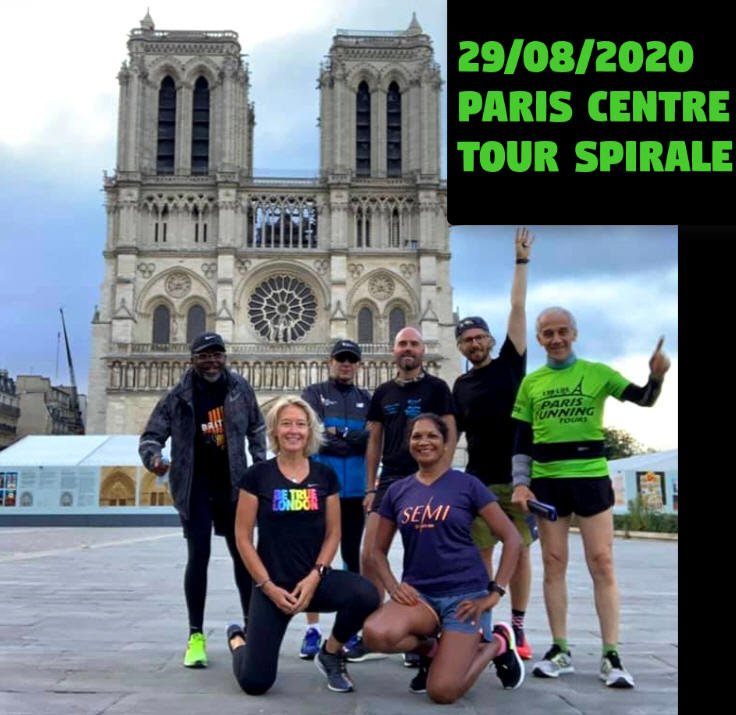
Running doing a spiral in the centre of Paris! So many things to discover or see again, to share the history of Paris, to understand the link between historical events and the physiognomy of the city, to have the joy of running together… a pleasant stroll (and the satisfaction of a shared drink in the beautiful garden of the Palais Royal after the effort…). Many thanks to Chrystelle, Eric, Flavien, Jérôme, Justice and Marie! Paris Running Tours: private tours or free outings, stay tuned! See you soon for new themed outings, we are full of ideas to show you around Paris 😀 If you too, you come to Paris, we will be very happy to run with you. Join us and discover Paris with authentic Parisians guides who will take you on the best sight running routes in Paris and who always have tons of secrets to share with you: Music: Vlad Gluschenko — Harmony License: CC BY 3.0: https://creativecommons.org/licenses/by/3.0/deed.en
A Paris Running Tour, it is simple: Running, Admire, Having Fun!
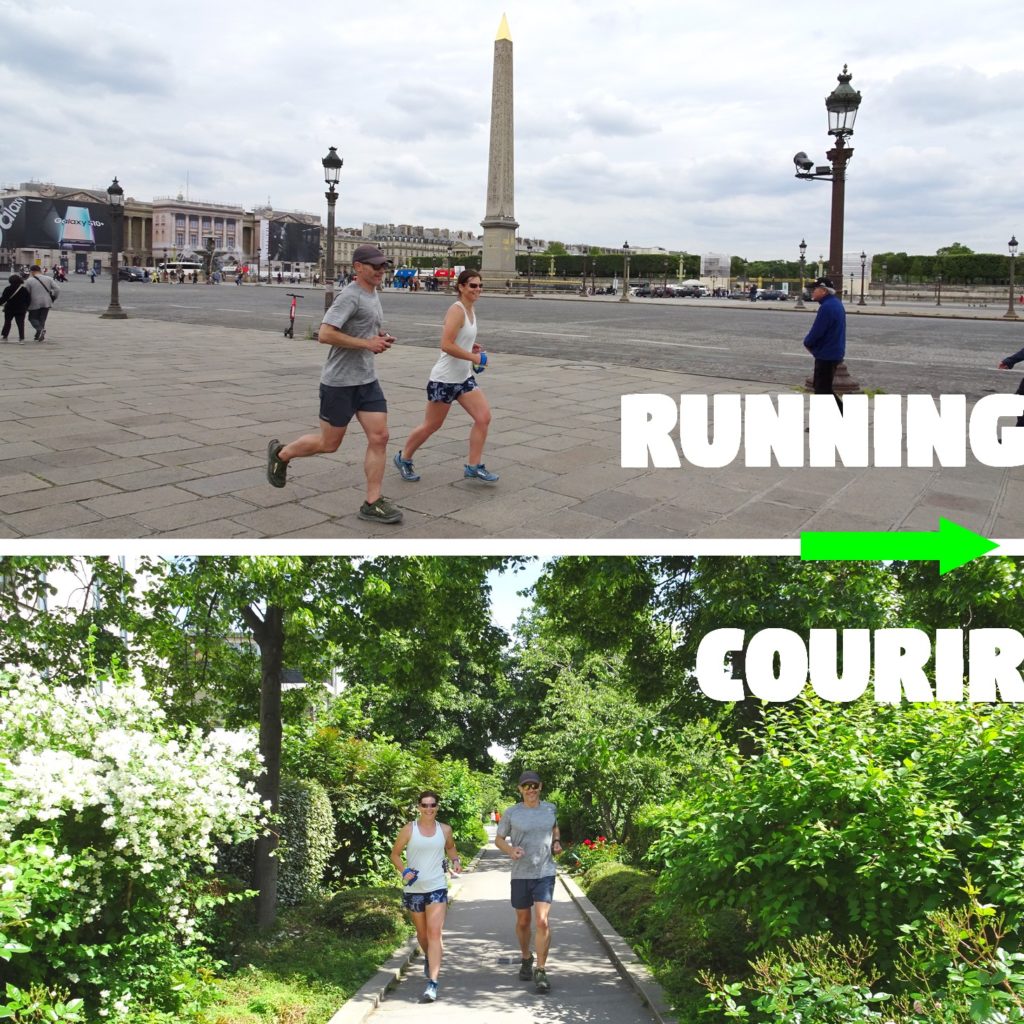
A Paris Running Tour, it is simple: we run, we admire, we have fun! Thanks a lot to Betsey and Jonathon for these very good moments! If you too, you come to Paris, we will be very happy to run with you. Join us and discover Paris with authentic Parisians guides who will take you on the best sightrunning routes in Paris and who always have tons of secrets to share with you:
12th, 14th, 16th, 17th and 19th centuries, a stroll in the History of Paris with Aveen and David
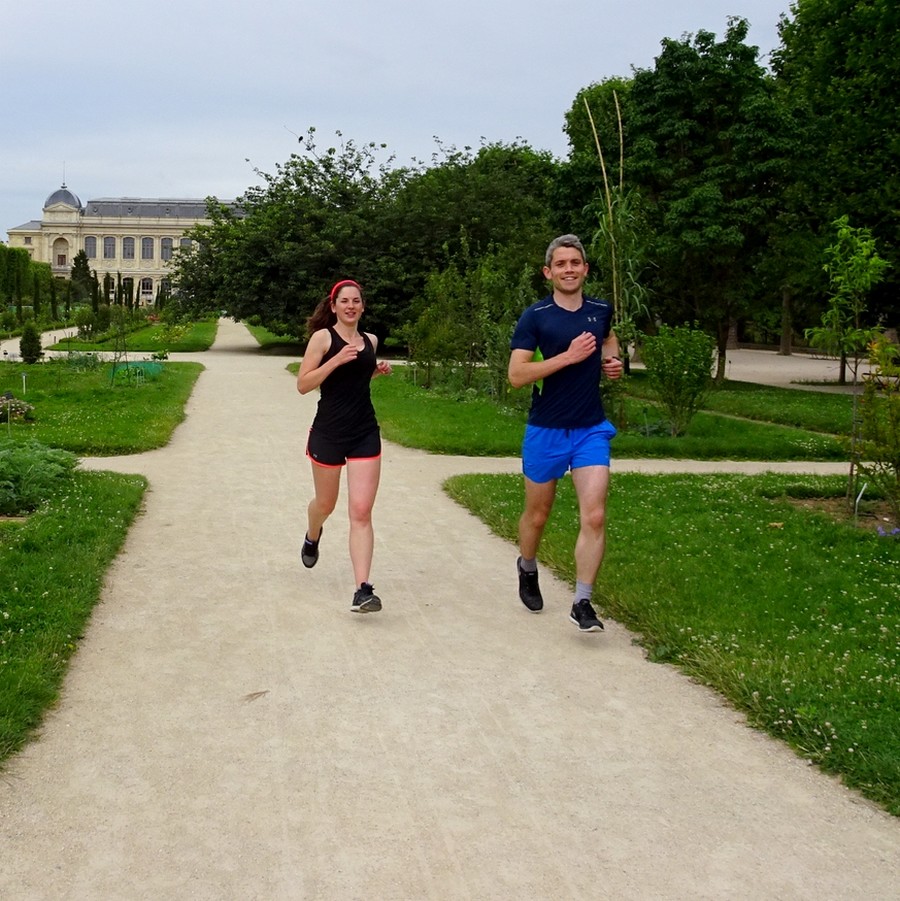
8:05 AM – With Aveen and David, confirmed runners from Dublin (Ireland), we explored Paris, by running and stopping in front of various buildings or places which restore the city such as it was in the previous centuries. Discovering “Le Marais”, the Left bank (Latin Quarter et “Saint-Germain des Près”), the Louvre and “Ile de la Cité” is a journey through the time and a way of feeling the History of Paris. Paris was damaged, bombarded but never totally destroyed as were London (Great fire of 1666) or Lisbon (Earthquake of 1755). In Paris, all the layers of History are represented (since the Roman Lutetia). Our route thus led us: in the 12th century with Notre-Dame, in the 14th century with the magnificent “Hôtel de Sens”, in the 16th century with the Carnavalet Museum (formerly “Hôtel de Carnavalet” and “Hôtel Le Peletier de Saint-Fargeau”) and the place Dauphine, also created at the end of the 16th century, Let us admire now four beautiful places appeared in the 17th century: The “Jardin du Luxembourg” (Garden of Luxembourg), The “Jardin des Plantes”, initially Royal garden of the Medicinal Plants created in 1626 (see the picture at the beginning of this article), The “Place des Vosges”, The “Hôtel de Sully”. Our road also passes in the 19th century with the “Place de la Contrescarpe”, created in 1852 in the location of a counter-scarp of Philippe Auguste’s surrounding wall (12th century). Merci Aveen ! Merci David ! The route of the tour:
Zigzags from Nation to Trocadero, 11 miles by running in Paris with Anne
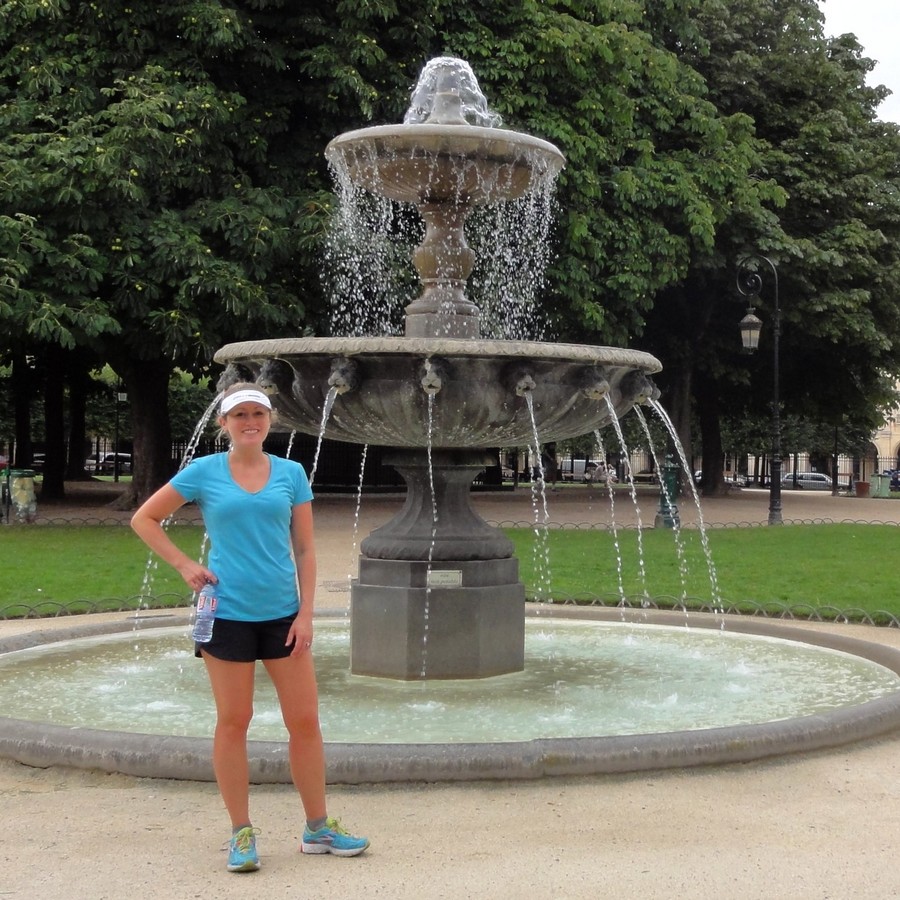
Anne – “Place des Vosges” 9:09 AM – Anne from Washington D.C. (USA) is a regular runner (look at her blog). In this first Monday of August, we had decided to cross Paris by running from east to west. We left a place near the square of “Nation” with the objective to reach “Palais de Chaillot” to take advantage of the beautiful view on the Eiffel Tower offered by the “Esplanade of the Trocadéro”. To go there by the shortest route? No, no, we chose to make a lot of zigzags to be able to appreciate Paris in all its magnificence. In the end, nearly 11 miles of an attractive tourist and sports route. First photo stop: the “Place des Vosges”. Very quiet this morning (photo above). Read here the funny short story of the statue of Louis XIII situated in the center of the garden. Did you know that this Royal place was renamed “Place des Vosges” because this department in the east of France was the first one to pay the tax during the Revolution? From “Place des Vosges”, to join the street Saint Antoine, we took the magnificent shortcut offered by the Hotel of Sully: Anne – “Hôtel de Sully” Still in the “Marais” (right bank), we are going to penetrate the Philippe Auguste’s Paris (by postern Saint-Paul). Indeed, king Philippe Auguste, at the end of the 12th century, before leaving for his third crusade, made build an important protective wall around Paris. Numerous parts of this surrounding wall are still visible nowadays. Below, the longest preserved portion of the wall. Discover here another massive part of the wall, left bank this time, as well as plans representing Paris of this time. Anne – Well of Phillippe Auguste – 12th century (Behind the wall, “Lycée” Charlemagne – High school) Let us cross the Seine to visit the Island of “La Cité”. Look (photo below) at the installations of “Paris-Plages” (Paris-beaches), right bank. Do you see the small red Eiffel Tower? We had spoken about it here and here. Anne – “Paris-Plages” Back right bank, surprise! A metro entrance (Palais-Royal station): Anne – “Métro Palais-Royal” (“Le kiosque des Noctambules” – Jean-Michel Othoniel) Compare this modern art subway entrance installed in 2000 with those created one hundred years earlier, representative of the “Art nouveau” movement: see here some examples of these metro entrances created in 1900. As a matter of fact, the other entrance of the same station, Palais-Royal, just in front of the Louvre, is typically “Art nouveau”. Zigzag, small detour on left bank, “Quai Anatole France”. Just in the opposite, the garden of the Tuileries which we are quickly going to join… Anne – “Quai Anatole France” …crossing the footbridge Léopold-Sédar-Senghor, which gives us a beautiful view on, from left to right, the Louvre, Notre-Dame and the Orsay museum: Anne – Footbridge Léopold-Sédar-Senghor In the garden of the Tuileries, here is a new example of modern art that we meet, a tree in bronze! Anne – “L’arbre des voyelles” (bronze molding installed in 1999 – Giusseppe Pepone) After other numerous discoveries, we finish our running as expected, Esplanade of the Trocadéro: Anne – “Esplanade du Trocadéro” Objective reached! Merci Anne ! The route of the tour :
Snapshots of a first visit in Paris, with Melinda
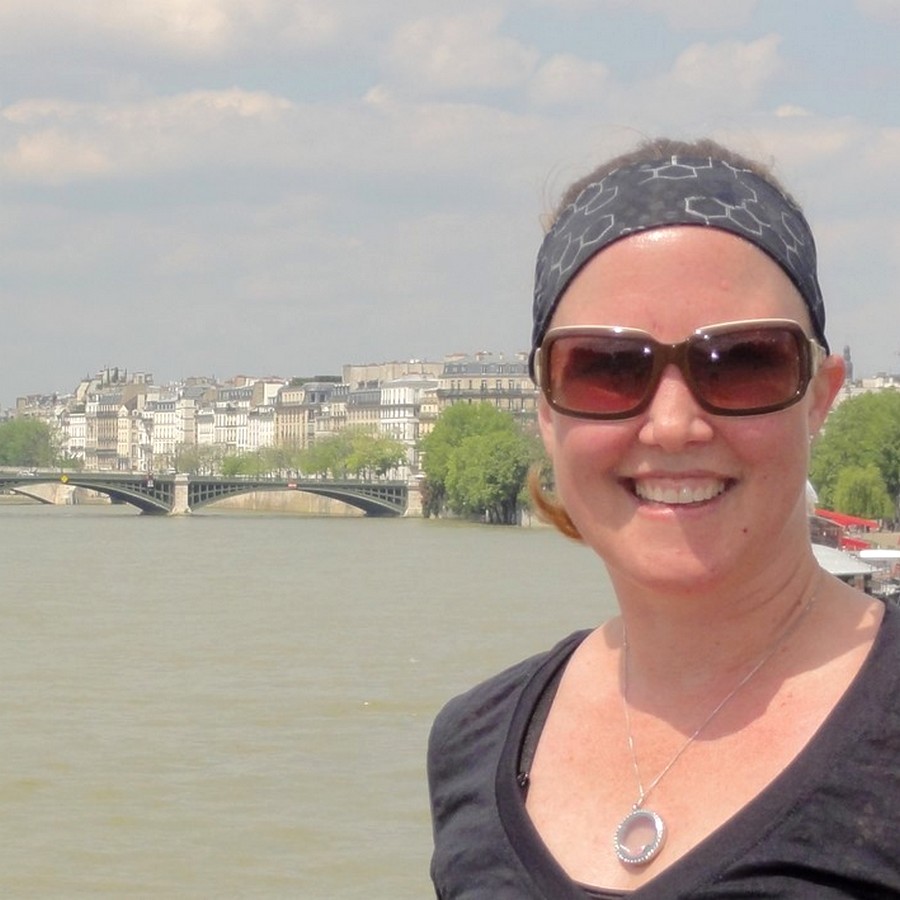
Melinda – On the bridge of Austerlitz. In the distance, Notre-Dame and Saint Louis Island beautiful houses Monday 27th May – 12:51 PM, Wednesday 29th May – 6:57 PM – First time in Paris for Melinda from Miami (USA) ! What better choice than to start a first stay in Paris doing a visit by running (with Paris Running Tour)? A good way of unwinding legs after a long travel by plane and a first discovery of Paris getting directly into the life of the city. And why not begin again two days later to discover new paths through Paris? We thus ran by following two routes which mainly crossed the disctrict of “Le Marais”, the Left bank, the island of “La Cité” and the center of Paris around the Seine. Here is the route (numbers indicate where the photos of this article were taken): We took numerous photos during our running: 1) “La rue des Barres” (Street of Bars). This name comes because formerly, in the 10th century, on the location of the street, a wall, a fence of wooden bars, constituted a wall protecting Paris: Melinda – “Rue des Barres” 2) “L’Hôtel de Sully” (The Hotel of Sully). The Duke of Sully, Minister of Finance of king Henri IV, lived in this noble mansion at the end of his life. By crossing the Hotel of Sully, we passed directly from the street Saint Antoine to the “place des Vosges”. Melinda – “Hôtel de Sully” 3) The “bassin de l’Arsenal”. Having crossed the place of the Bastille, we met the Basin of the Arsenal, port and canal connecting the river Seine with the Saint Martin canal and which, formerly, was a ditch which filled the moats of the castle of the Bastille. Melinda – “Port de l’Arsenal” 4) “Pont d’Austerlitz” (Bridge of Austerlitz). See the picture at the beginning of the article. 5) “Cour du Commerce Saint André”. Another place which is situated on the plan of the former surrounding wall of Paris, the wall of king Philippe Auguste. This passage, opened in 1776, allows to reach the Café Procope (1686), one of the oldest cafés in the world. Melinda – “Cour du Commerce Saint André” Second tour : 6) “Le Tribunal de Commerce de Paris” (Commercial court). This building presents the peculiarity to have a dome placed not in the center, but on the side, in a way that the dome is visible from the Boulevard Sevastopol. The dome closes the perspective of the Boulevard by the South. Melinda – On the bridge Notre Dame. We can see, on the island of “La Cité”, successively, the Hôtel-Dieu (Hospital), the “Tribunal du Commerce de Paris” and the Conciergerie. 7) On the “Pont Neuf” (“New” Bridge). Melinda – Pont Neuf. On left, the “Institut de France”, the Eiffel tower and, on right,the “Musée d’Orsay” 8) Colonnade of the Louvre. Summit of the French classicism, the Colonnade of the Louvre was realized at the request of king Louis XIV. The Colonnade of the Louvre served as model to numerous famous buildings, in particular, the Capitol of the United States in Washington, Metropolitan Museum of art in New York and San Francisco War Memorial Opera House. Melinda – The “Colonnade du Louvre” 9) Alexandre III bridge. The widest bridge in Paris. Built with the “Grand” and “Petit Palais” for the World Fair of 1900. The bridge offers a direct link between the “Invalides” and the Champs-Elysées. Melinda – the Alexandre III bridge – In the distance, the “Invalides” 10) The Champs Elysées. Melinda – Champs Elysées, at the end, the “Arc de Triomphe” and far off, the “Grande Arche” of “la Défense” 11) The equestrian statue of Joan of Arc, place of the Pyramids. She is situated not far from the Gate Saint Honoré, where Joan of Arc tried to cross Charles V’s surrounding wall to reconquer Paris, occupied at the time by the English. She was hurt by an arrow in the thigh there. Melinda – Equestrian statue of Joan of Arc, of Frémiet and inaugurated in 1874 12) The Puget courtyard in the Louvre. Melinda – Puget Courtyard, situated with the Marly Courtyard on both sides of the passage which connects the Louvre Pyramid to the street of Rivoli 13) Stravinsky fountain. This fountain, fountain Stravinsky or fountain of automatons, was created by the couple of artist Nikki de Saint Phalle and Jean Tinguely in 1983 and evokes the work of the composer Stravinsky. Melinda – the “Fontaine Stravinsky”, on the right George Pompidou Center Interesting and beautiful discoveries, isn’t it? Merci Melinda ! The route of the tours:
In front of the oldest tree of Paris with Michael
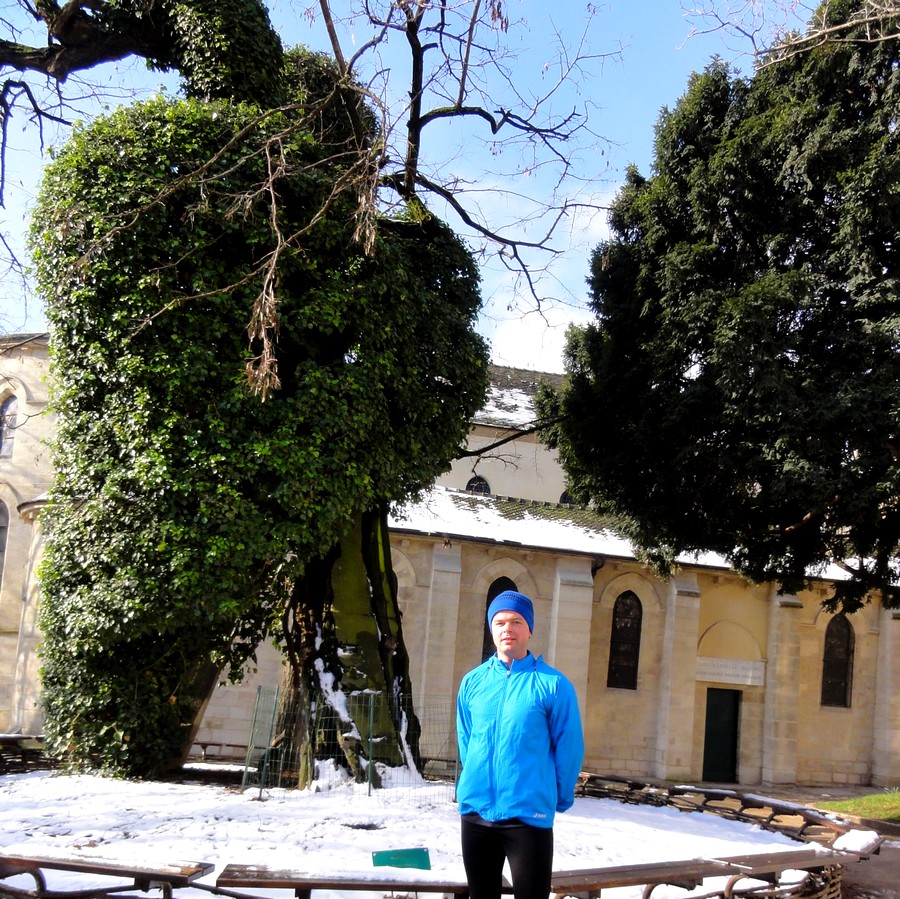
Michael – Garden René Viviani, in the background the church “Saint-Julien le Pauvre” 9:01 AM – Michael, who lives in Hamburg (Germany), began his first visit of the capital by a Paris Running Tour. Having left the district of the “Gare de Lyon”, we traveled the garden of Plants, crossed the Latin Quarter on the left bank, visited the Island of “La Cité”, then of return on the right bank, saw the Pompidou Center and the “Marais” quarter. We discovered in particular the Gallo-Roman Paris by admiring the Arenas of Lutecia, the Roman Thermal baths and the archaeological crypt where we can see real Roman streets. Before leaving the Latin Quarter, in the Public garden René Viviani, we greeted the oldest tree of Paris (we can see it on the photo above). This Black Locust tree (Robinia pseudoacacia) was planted in 1601 by the botanist Jean Robin who introduced it in France (the tree is native of North America). The public garden René Viviani faces the Cathedral Notre-Dame-de-Paris as we can see on the photo below: Michael – “Square René Viviani” and Notre-Dame de Paris A little earlier, it is another place of worship we crossed, the Big Mosque of Paris: The “Grande Mosquée” of Paris The Big Mosque of Paris was inaugurated in 1926. Of Spanish-Moresque style, it possesses a 33 meter minaret. The Mosque is opened to the tourist visits. On the right bank, very close to another “temple”, “temple” of the culture this time, the Georges Pompidou Contemporary Arts Center, we contemplated beautiful mural paintings, of which the stencil “Chuuuttt!!!” of Jef Aérosol: Michael – “Chuuuttt !!!” from Jef Aérosol (2011) In the “Marais”, we took a shortcut which made us, directly from the street Saint Antoine pass on the beautiful “Place des Vosges”: Michael – “Hôtel de Sully” A magnificent shortcut, the Hotel of Sully! This “Hôtel particulier” (mansion) allows to join the “place des Vosges” by way of the inside courtyard and the garden. Built at the beginning of the 17th century, it was the property of the “Duke de Sully”, king Henri IV’s Minister of Finance. It shelters now the Center of the National Monuments. Merci Michael ! The route of the tour :
Place des Vosges with Anne and Niels
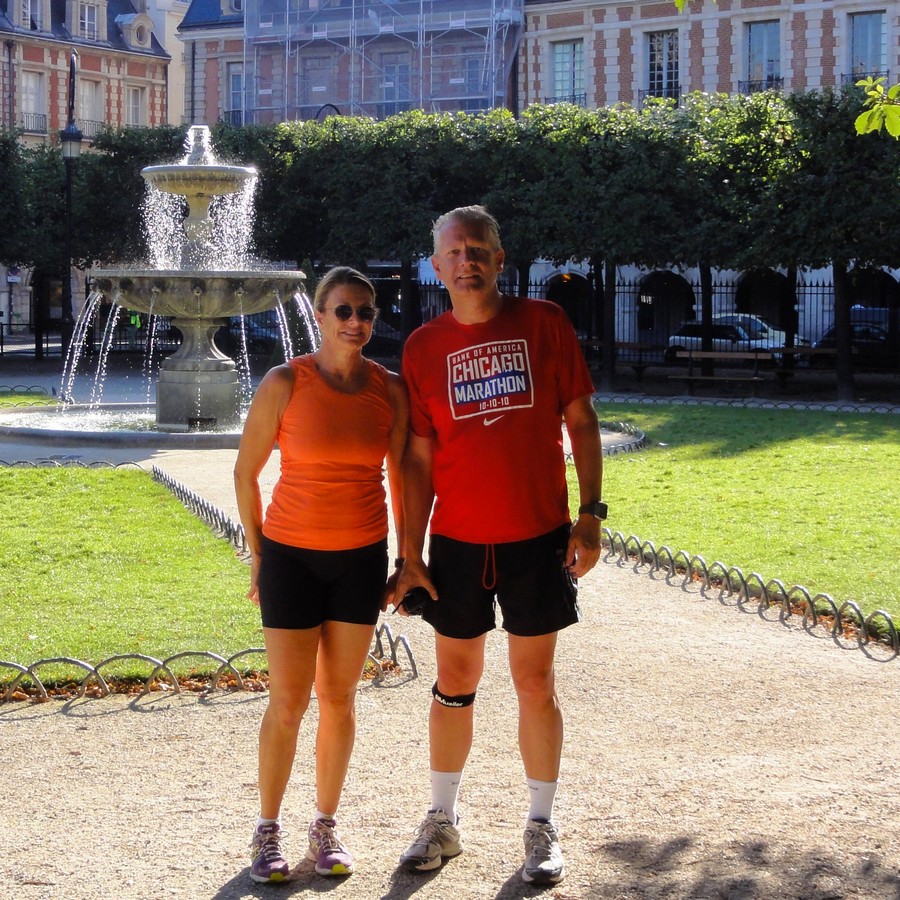
Anne et Niels – Place des Vosges 8:08 AM – It was a great pleasure to meet Anne and Niels from Denmark again. We had run together during a rather cold March, two tours in Paris, for the greater part on the left bank. This time, in this warm day of August, we chose the right bank and followed the plan of the ancient Paris surrounding wall of King Louis XIII, path which constitutes largely what we name “Les Grand boulevards”. To join the Grand boulevards, we went through some of the numerous covered passages of Paris, in particular the “passage des Panoramas”: Anne and Niels – Passage des Panoramas Deserted passage on a Sunday morning and thus usable by the runners! The passage of the Panoramas is one of oldest covered passages of Paris, created in 1799 and doubtless inspired by the oriental souks… The name “panoramas” comes because the main entry was framed by two towers where were exposed panoramic landscapes representing big cities, panoramas. On the Grand boulevards, we admired two big triumphal arches commissioned by king Louis XIV: the “Porte Saint-Martin” (1674) and the “Porte Saint-Denis” (1672). Both arcs were built to the glory of Louis XIV and of his victories and replaced the fortified doors become useless, Charles V’s wall being replaced by the Boulevard. Anne et Niels – Porte Saint Denis We then left the Boulevard to find the “Place des Vosges”: Anne et Niels – Place des Vosges Look closer at the Louis XIII’s statue. To replace the former bronze statue, melted during the Revolution, the sculptors chose the marble, indeed much heavier… The statue threatening to collapse in its center, it was decided to place a trunk under the horse’s belly. It gives a very strange look to this equipage, slowed down in its center by a tree trunk! Merci Anne et Niels ! The route of the tour :
Along canal Saint-Martin and river Seine with Kristina
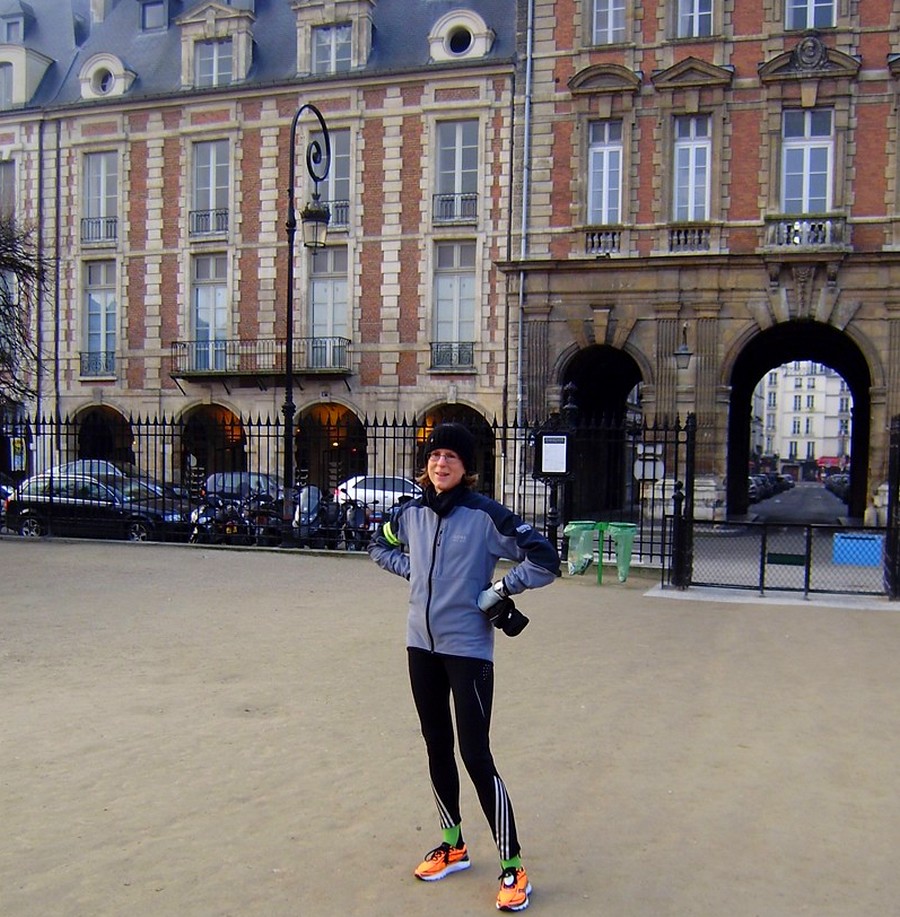
Place des Vosges – Kristina 7:30 AM – Saturday and Monday – Kristina, from Freising (Germany), is a regular runner. As Anne and Niels, she decided to fully enjoy Paris while running, choosing to run twice with Paris Running Tour, Saturday and Monday morning. First tour, a jogging along the canal Saint Martin, following the “Quai de Valmy”, the “Quai de Jemmapes”, going by “la place de La Bastille” and along the Arsenal Marina. Second running tour, a run along the Seine, enjoying the “Ile de la Cité” with Notre Dame, La Sainte Chapelle and La Conciergerie, afterward the left bank, then after admiring the Musee d’Orsay, the right bank and back to the start, through “Les Tuileries” and “Le Louvre”. On our way, La place des Vosges: The king Henri IV created “La place Royale” at the beginning of the 17th century. This squared place was conceived with a rigorous architectural design (same style for each house, arcades and pillars, …) The place inspired many European residential squares. In 1799, when was raised taxes to support the campaigns of the Revolutionary armies, “Les Vosges” was the first department to pay (department in the east of France); Paris thanked “Les Vosges” naming the square “La place des Vosges”. Many famous persons lived there, as Victor Hugo (you can visit his house). Merci Kristina! The routes of the tours (Saturday and Monday ):