In front of the Embassy of Texas in Paris with Kristina
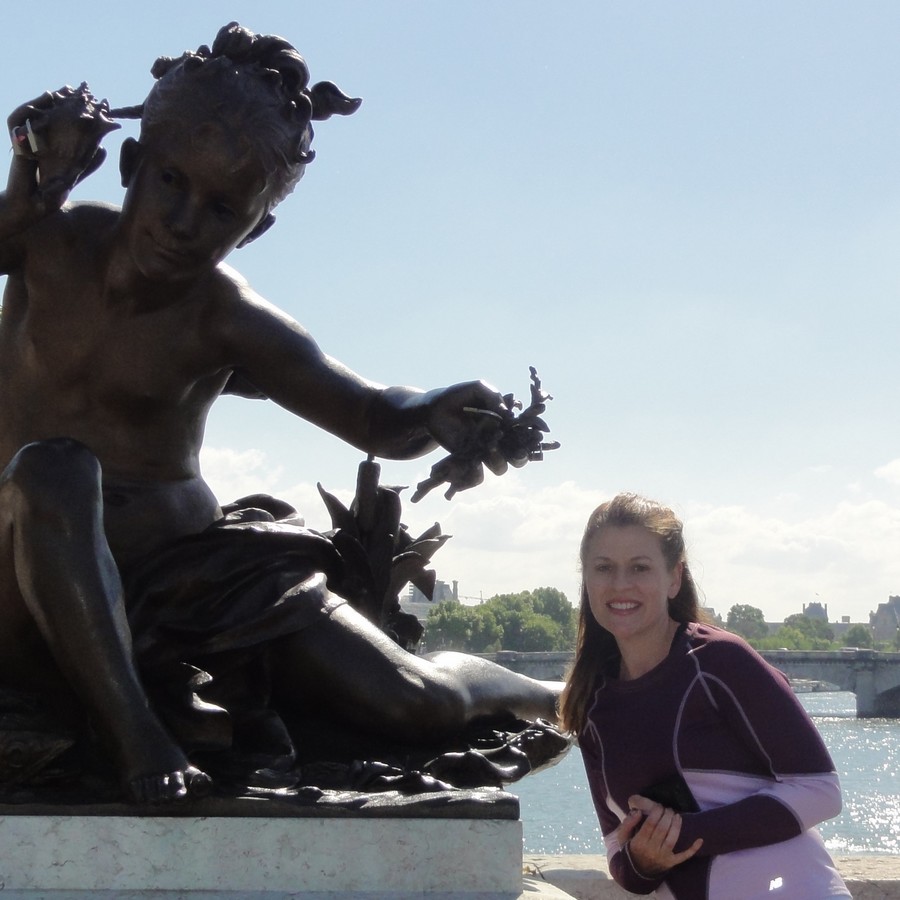
Kristina – Alexandre III bridge – “La fillette à la coquille” (the girl with the shell), sculpted by Léopold Morice 9:55 AM – Kristina lives just in front of Manhattan (New York). We ran and discovered Paris on a beautiful morning of May. The magnificent Alexandre III bridge presents numerous groups of statues. Some evoke diverse representations of the Fame, others, France in various periods of its history. The girl with the shell, which we can see on the photo above, is a member of numerous statues bound to the marine world (the Nereid, the child and the fantastic fish, dolphins and other shells). It is a pity people hung on to it padlocks (look at the hands of the statue by enlarging the photo).. Very close to the place where we started our running, Place Vendôme, we met the Embassy of Texas! Kristina – “Embassy of Texas” Embassy of Texas? Yes, read the plaque which we can see on the building behind Kristina: It is written: “Embassy of Texas. In 1842-1843 this building was the seat of the Embassy of the Republic of Texas in Paris. With the Franco-Texan Treaty of 29 September 1839 France became the first nation to recognize the Republic of Texas, an independant state between 1836 and 1845.” A little farther, after having run in the magnificent Garden of the Tuileries, Kristina – Jardin des Tuileries It is in front of another place of political representation that we stop: Kristina – Palais de l’Elysée – “La Grille du Coq” The Palace of “Elysée”, official residence of the President of the French Republic. Look at the railing which closes the garden of the Palace south side: it is the Railing of the Gallic cockerel. Remember, we had spoken about this cock here. By continuing our road towards the Eiffel Tower, we pass by a street the name of which evokes a city well known by Kristina: Kristina – Avenue de New-York In 1918, this way is named Avenue of Tokio (with one “i” as it was the custom at the beginning of the 20th century). At the end of the World War I, the avenue receives this name because Japan was an ally of France. In 1945, the avenue of Tokio is renamed avenue of New York, the most populated city of the United States, the country which participated in the France liberation (Japan having become an enemy during the World War II). The Palace of Tokyo, very close, built for the World Fair of 1937, kept its name. We were lucky! By going to the Eiffel Tower, the cannons of the garden of Trocadéro throw their powerful water jets: Kristina – Jardin du Trocadéro Merci Kristina ! The route of the tour:
Four mornings to explore Paris with Sarah
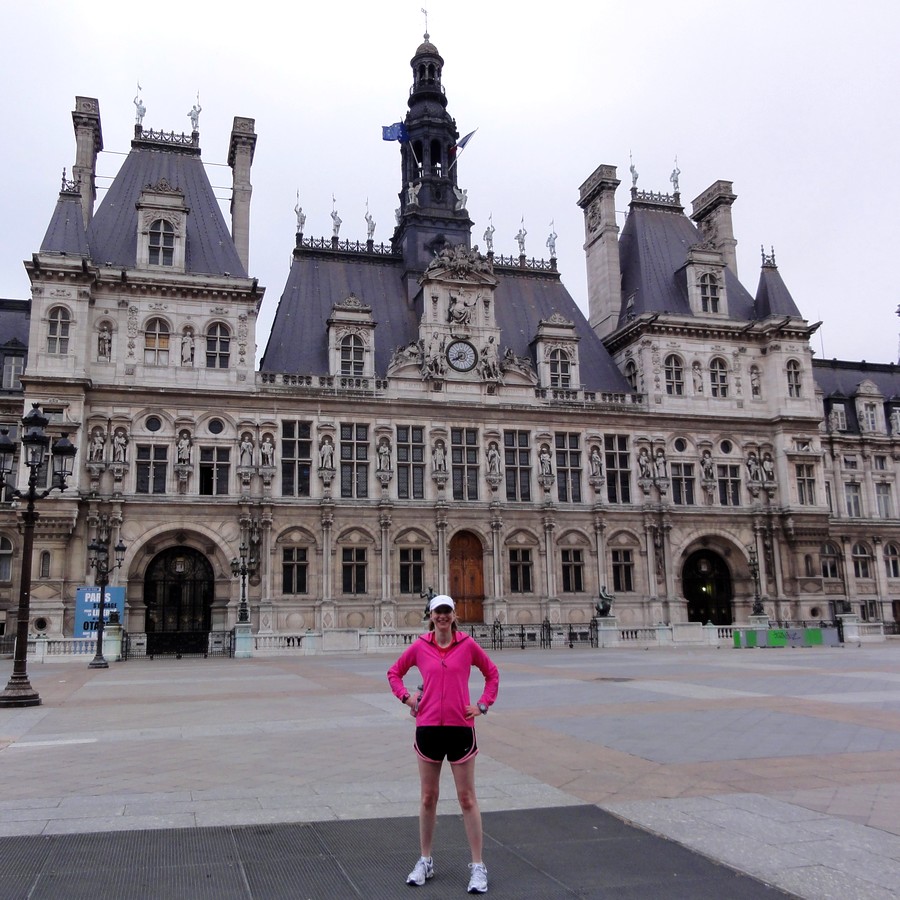
Sarah – Hôtel de Ville 6:30 AM – Sarah of Houston (USA), wished to discover Paris by running four following mornings with Paris Running Tour. It is thus with a big enthusiasm that we investigated the center of Paris as well right bank as left bank (see routes at the end of the post). Did you know that the metric system was set up during the Revolution? The National Convention (constitutional and legislative revolutionary assembly), to generalize the use of the metric system disposed sixteen marble standard meters at the most frequented places of Paris. These meters were installed between February, 1796 and December, 1797. With Sarah, during our explorations, we found both last ones which remain at present in Paris, the one of the right photo being the only one still on its original site: Standard meter Place Vendôme – Standard meter street of Vaugirard On the “grands boulevards”, we discovered two triumphal arches: Porte Saint-Martin – Porte Saint-Denis Yes, before the Arcs of Triumph wanted by Napoleon the 1st, place de l’Etoile and in the Carrousel of the Louvre, Louis XIV ordered the construction of these two Arcs in honor of his military victories (See the inscription at the top of the Arcs: “Ludovico Magno”, Louis the Great). Louis XIV, Sun King did not only make Versailles! The Arc of “La Porte Saint Denis” (“Porte”=door) and the Arc of “La Porte Saint-Martin” are in the location of former fortified doors of Paris, both belonging to the surrounding wall of king Charles V. Indeed, the “Grand boulevards” which we know now correspond to the ancient surrounding fortifications of Paris, built by Charles V, widened by Louis XIII, then destroyed under Louis XIV The word “Boulevard” comes moreover from the word “Bolevers” which comes itself from the ancient Dutch word “Bolewerk” meaning “Ramparts”. From the Charles V’s surrounding wall (1383) to the “nouveau Cours” (1705 ) – Representation of the door Saint-Martin See these trees planted all along the Boulevard. The Parisians called them “boules vertes” (Green balls). Boules vertes = Boulevards! Other origin of the word! Among our other historic explorations, we found the ancient Arenas of Lutetia (Lutetia = Paris before the third century later JC). They were accidentally discovered by chance during works in 1870. These Roman arenas could contain more than 10000 spectators. Under their eyes took place gladiators’ fights, fights of wildcats but also representations of comedies or dramas. Sarah – Arenas of Lutetia Nowadays, it is a quiet place for games of balls or tournaments of petanque. From time to time, theater companies play there. Merci Sarah ! The routes of the four tours:
To close a working stay in Paris, a Running tour!
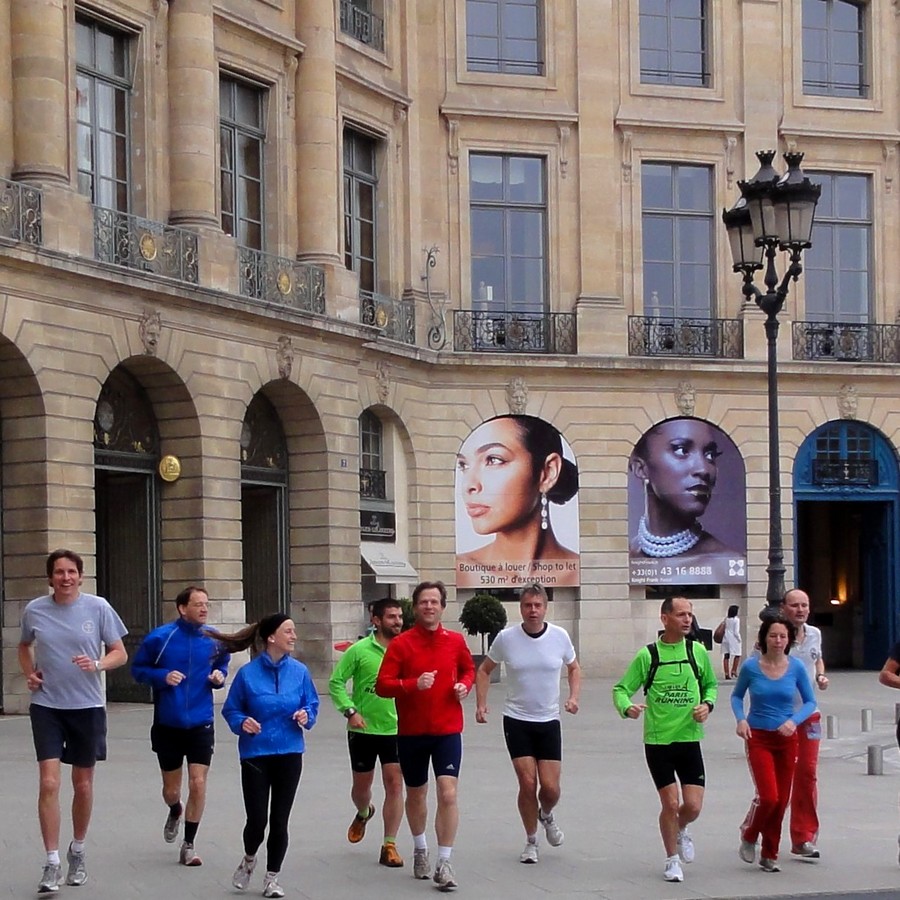
Running Place Vendôme 9h43 – In this month of April, an important international company had an executive management meeting a few days in Paris. At the end of the working stay, a day of relaxation was dedicated to the visit of the capital. A sports tour of Paris was organized: there is nothing like running to fully relax. We, Vincent, Frédéric and Jean-Charles, accompanied the group of runners for a tour following the right and the left banks of the Seine, passing by the place Vendôme, the Tuileries, the Champs Elysées, the Eiffel Tower, the Louvre and the Opera Garnier. Thanks to them! In front of the Eiffel tower The Eiffel tower: Did you know it? From the beginning of the Eiffel Tower, five hydraulic elevators transported the visitors. In this time, for such a height and of such weights, it was a real technical exploit. For a long time, these elevators were driven by a pilot who was outside of the cabin. He bore the cold or the heat according to the seasons… A life-size reproduction of this pilot is on one of the elevators. Try to see him through the window of the elevator: Elevator pilot! The route of the tour :