Snapshots of a first visit in Paris, with Melinda
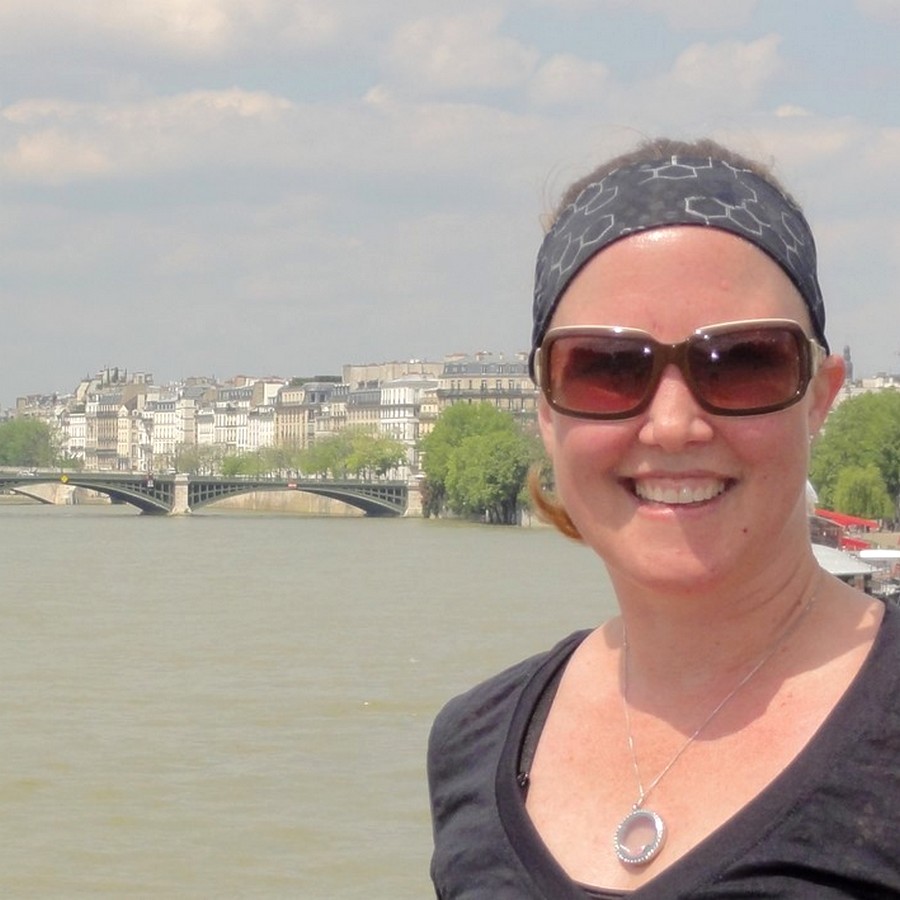
Melinda – On the bridge of Austerlitz. In the distance, Notre-Dame and Saint Louis Island beautiful houses Monday 27th May – 12:51 PM, Wednesday 29th May – 6:57 PM – First time in Paris for Melinda from Miami (USA) ! What better choice than to start a first stay in Paris doing a visit by running (with Paris Running Tour)? A good way of unwinding legs after a long travel by plane and a first discovery of Paris getting directly into the life of the city. And why not begin again two days later to discover new paths through Paris? We thus ran by following two routes which mainly crossed the disctrict of “Le Marais”, the Left bank, the island of “La Cité” and the center of Paris around the Seine. Here is the route (numbers indicate where the photos of this article were taken): We took numerous photos during our running: 1) “La rue des Barres” (Street of Bars). This name comes because formerly, in the 10th century, on the location of the street, a wall, a fence of wooden bars, constituted a wall protecting Paris: Melinda – “Rue des Barres” 2) “L’Hôtel de Sully” (The Hotel of Sully). The Duke of Sully, Minister of Finance of king Henri IV, lived in this noble mansion at the end of his life. By crossing the Hotel of Sully, we passed directly from the street Saint Antoine to the “place des Vosges”. Melinda – “Hôtel de Sully” 3) The “bassin de l’Arsenal”. Having crossed the place of the Bastille, we met the Basin of the Arsenal, port and canal connecting the river Seine with the Saint Martin canal and which, formerly, was a ditch which filled the moats of the castle of the Bastille. Melinda – “Port de l’Arsenal” 4) “Pont d’Austerlitz” (Bridge of Austerlitz). See the picture at the beginning of the article. 5) “Cour du Commerce Saint André”. Another place which is situated on the plan of the former surrounding wall of Paris, the wall of king Philippe Auguste. This passage, opened in 1776, allows to reach the Café Procope (1686), one of the oldest cafés in the world. Melinda – “Cour du Commerce Saint André” Second tour : 6) “Le Tribunal de Commerce de Paris” (Commercial court). This building presents the peculiarity to have a dome placed not in the center, but on the side, in a way that the dome is visible from the Boulevard Sevastopol. The dome closes the perspective of the Boulevard by the South. Melinda – On the bridge Notre Dame. We can see, on the island of “La Cité”, successively, the Hôtel-Dieu (Hospital), the “Tribunal du Commerce de Paris” and the Conciergerie. 7) On the “Pont Neuf” (“New” Bridge). Melinda – Pont Neuf. On left, the “Institut de France”, the Eiffel tower and, on right,the “Musée d’Orsay” 8) Colonnade of the Louvre. Summit of the French classicism, the Colonnade of the Louvre was realized at the request of king Louis XIV. The Colonnade of the Louvre served as model to numerous famous buildings, in particular, the Capitol of the United States in Washington, Metropolitan Museum of art in New York and San Francisco War Memorial Opera House. Melinda – The “Colonnade du Louvre” 9) Alexandre III bridge. The widest bridge in Paris. Built with the “Grand” and “Petit Palais” for the World Fair of 1900. The bridge offers a direct link between the “Invalides” and the Champs-Elysées. Melinda – the Alexandre III bridge – In the distance, the “Invalides” 10) The Champs Elysées. Melinda – Champs Elysées, at the end, the “Arc de Triomphe” and far off, the “Grande Arche” of “la Défense” 11) The equestrian statue of Joan of Arc, place of the Pyramids. She is situated not far from the Gate Saint Honoré, where Joan of Arc tried to cross Charles V’s surrounding wall to reconquer Paris, occupied at the time by the English. She was hurt by an arrow in the thigh there. Melinda – Equestrian statue of Joan of Arc, of Frémiet and inaugurated in 1874 12) The Puget courtyard in the Louvre. Melinda – Puget Courtyard, situated with the Marly Courtyard on both sides of the passage which connects the Louvre Pyramid to the street of Rivoli 13) Stravinsky fountain. This fountain, fountain Stravinsky or fountain of automatons, was created by the couple of artist Nikki de Saint Phalle and Jean Tinguely in 1983 and evokes the work of the composer Stravinsky. Melinda – the “Fontaine Stravinsky”, on the right George Pompidou Center Interesting and beautiful discoveries, isn’t it? Merci Melinda ! The route of the tours:
Running under the bridge Saint-Michel with Antje
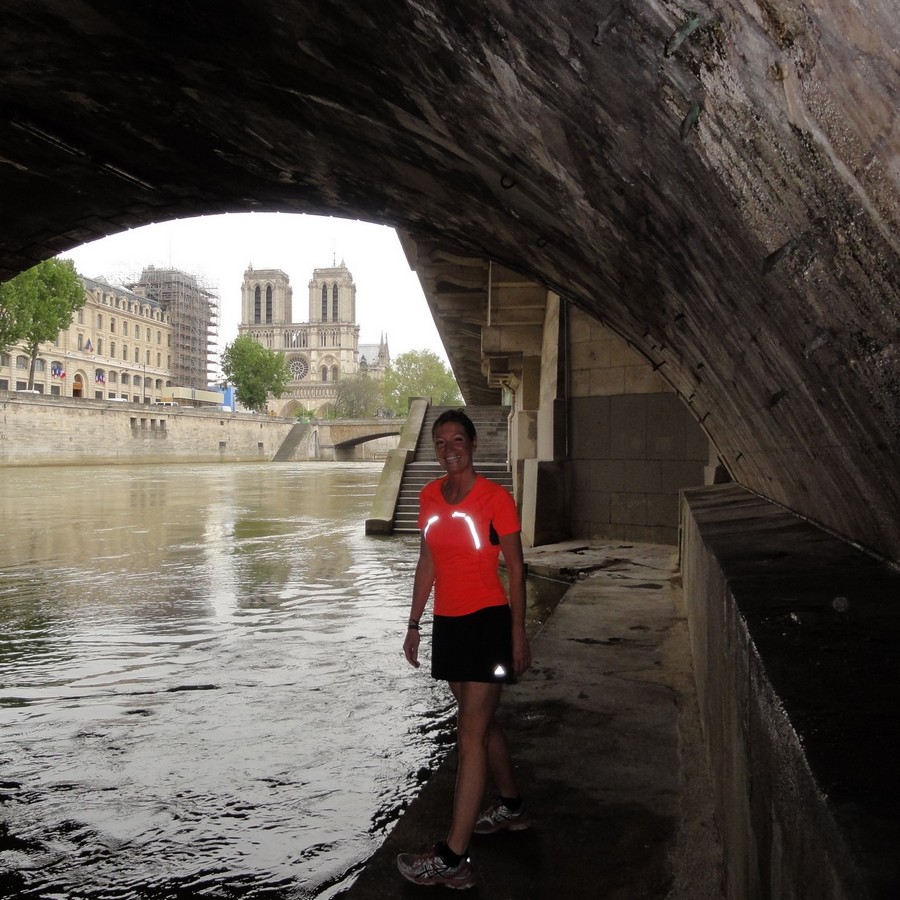
Antje – Under Saint-Michel bridge – In the background, “Notre-Dame de Paris” 7h57 – Antje comes from another great and beautiful European capital, Berlin. She already ran several times the Berlin marathon, one of the fastest world marathons (the last four world records were realized in Berlin). Antje knows well Paris and that is with pleasure and while running that we rediscovered its most beautiful “paths”. A beautiful route of more than 14 km also passing under bridges of Paris as we can see on the photo above. Our running led us of the Eiffel Tower up to Notre-Dame, then up to the Arc of Triumph. This Friday was making the “bridge” between two holidays, May 8th&9th and the weekend so Paris was very quiet, even the Eiffel Tower seemed deserted (at least at 8 am in the morning). Antje – “Champs de Mars” and Eiffel tower Notice the scaffolds which leave the ground towards the first floor of the Eiffel Tower. These temporary elements are of use to the renovation of the first floor. The objective of this modernization project is to make this floor a more attractive place => Click here. Back from Notre-Dame, this time, it is ON the “Pont Neuf”, the New Bridge, that we ran: Antje – “Pont Neuf” – In the background, the “Pont des Arts” (bridge of the Arts) As its name does not indicate it, the “Pont Neuf”, literally “New Bridge”, is the oldest bridge of Paris. As you can read it on the photo, the bridge was built at the end of the 16th century. Yes, “neuf” means “new” (and not “9”). Is the oldest bridge the new bridge? Indeed, at the time of its construction, this bridge was very modern: all in stone, without houses on its edges (at last, we could know that we were really on a bridge while crossing it, impossible with houses!), and with sidewalks! These sidewalks were really new because very rare in Paris at that time… The “Pont Neuf”, already at that time, a beautiful place to stroll, to appreciate the sight and Paris! Farther, we pursued our route along the historic axis of Paris (see here), the Louvre, the Louvre Pyramid and the garden of the Tuileries : Antje – “Cour carrée du Louvre” Antje – Small break near the Louvre Pyramid Antje – In the garden of the Tuileries We then continued our road along the Champs-Elysées to go uphill towards the Arc of Triumph. Uphill? Yes indeed, do you know that the Arc of Triumph is put on what we called formerly the “colline du Roule” (The hill of the Roule). In 1768, this hill was leveled to have a more regular slope towards the Gate of Neuilly. The top of the hill was then 5 meters higher. Paris as flat as Berlin? Hem, not completely… So remember, when you will take the departure of the Paris marathon and will start with the Champs-Elysées, do not run too fast: if it is so easy, it is because you are in descent! Merci Antje ! The route of the tour:
Paris Competitions News: Ready for the 2013 Paris Marathon?
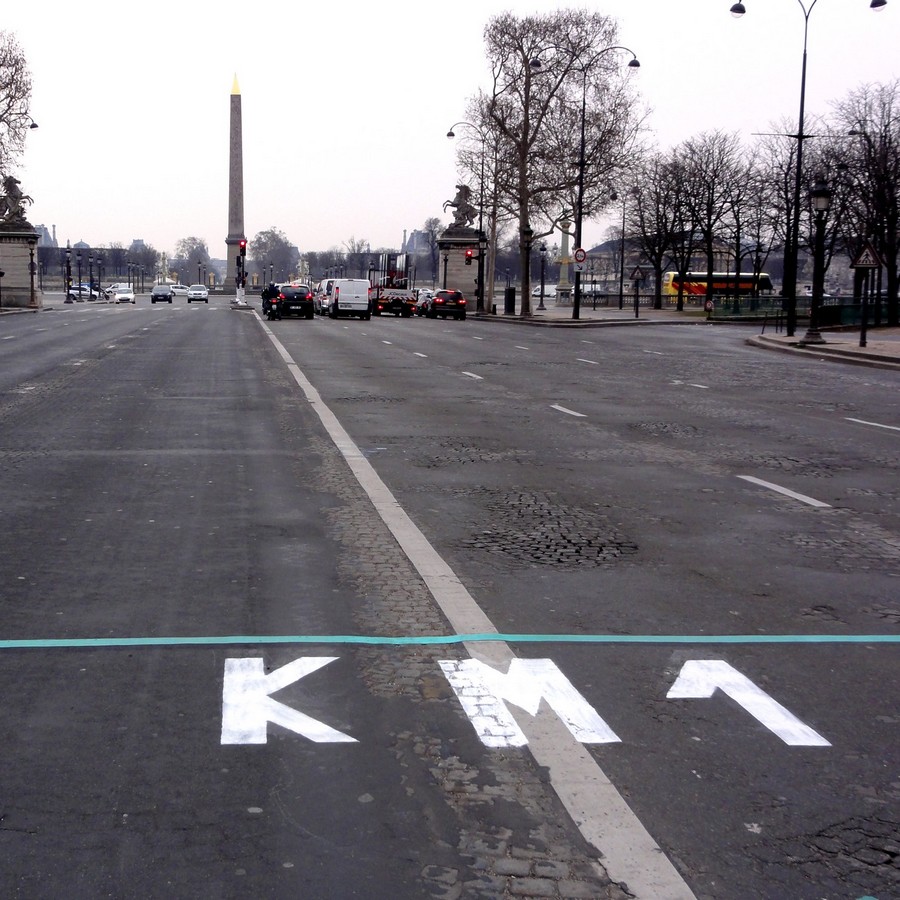
Champs-Elysées – Kilometer 1 – Just before “place de la Concorde” before turning left to the Rivoli street In spring, strange signs appear on the Parisian road, blue lines accompanied by indications which seem to be coded: “KM1”, “KM2”, “KM3”, etc. These are the kilometric marks of the Paris marathon! In other places, all the miles are indicated too. On the photo above, the first kilometer. Magic kilometer going down the Champs-Elysées. Imagine, you are in the middle of the road of one of the most beautiful avenues and you are running applauded by the crowd! Take care, in spite of the enthusiasm, don’t lose your head. If it seems to be easy, it is because you are running downhill. keep your energy. One kilometer earlier, the start, in the middle of the Champs-Elysées. The mark is already present: The 2013 Paris marathon start at the level of the Marbeuf street Here you are, ready to make a magnificent route in Paris. Find the route in detail by clicking the image below, with a view of monuments, buildings, streets: Having crossed and taken advantage of Paris up and down, here you are, very close to the finish, in the kilometer 42: Avenue Foch – 42th kilometer – In the background, the Arc of Triumph Only 195 meters to go (enjoy it, this moment is extraordinary) and you arrive! Here is the location of the finish, rather discreet for the moment: The finish line ! Behind the Arc of Triumph, the Champs-Elysées from where the Marathon started! We wish you a beautiful Paris Marathon!
Grande Arche – Arc de Triomphe return trip with Maggie
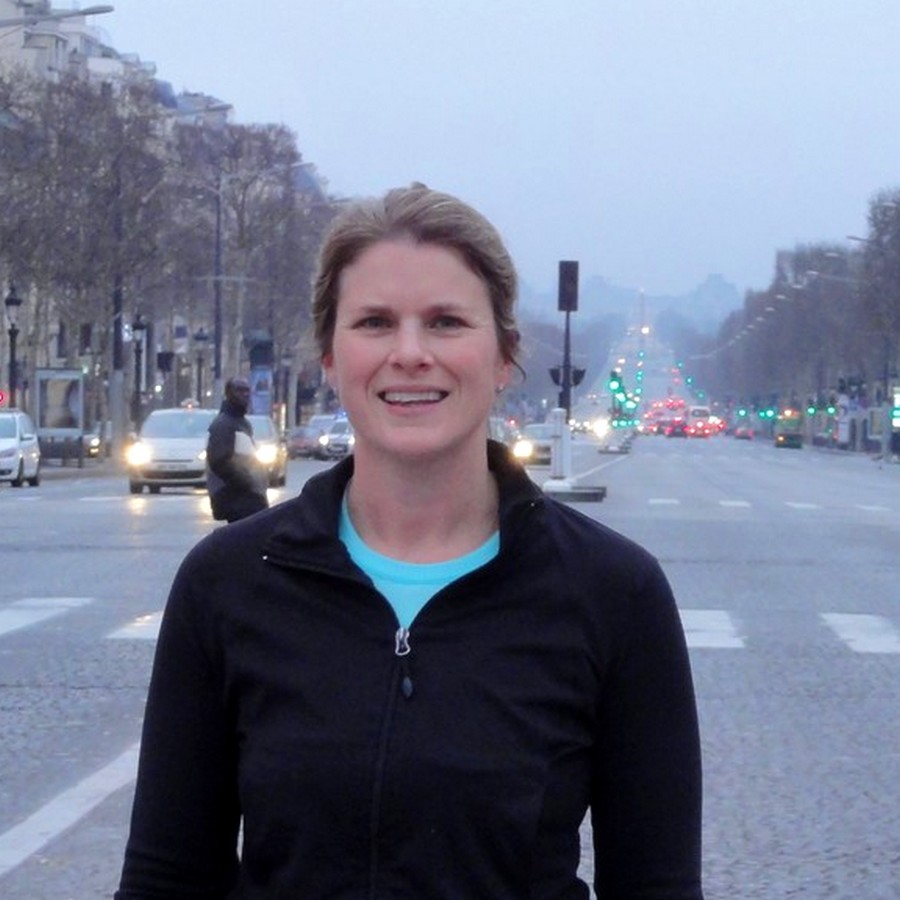
Maggie (in front of the Arc of Triumph) – Champs-Elysées 6:51 AM – Maggie, who lives near Houston, runs very regularly. Early on Sunday, we ran on the West part of the Paris historical axis (map here), from “La Défense” up to the Arc of Triumph. We thus left “La Défense” to cross its esplanade, the city of Neuilly, the avenue of the “Grande Armée” and join the Arc of Triumph on the “Place de l’Étoile” (place of the Star). We went around the “Arc de Triomphe”, admired the other part of the historical axis: Champs-Elysées, far off, the obelisk of “La Concorde” then, at the end, the Louvre (on the photo above, by enlarging it, we can see the Obelisk and the buildings of the Louvre far off). Maggie – The “Arc de Triomphe” On returning to “La Défense”, we were able to appreciate some of the numerous works of art arranged on the Esplanade, as “the pond of Takis” created by Vassilakis Panayotis Takis: Maggie – The “Bassin” of Takis (1988) – The “Grande Arche” of “la Défense” or “Le Moretti” (“Cheminée Moretti”) of Raymond Moretti : “Cheminée Moretti” (1995) “La Défense” is the biggest business center in Europe. On this Sunday morning, the esplanade of “La Défense” was deserted, contrary to the working periods when the paving stone of “La Défense” is full of businesswomen and businessmen who join or leave their offices. La Défense (Click on the picture for a larger view) By the way, do you know why this business area is called “La Défense”? In 1883, the Statue of the defense of Paris was placed on a traffic circle of Courbevoie, one of the cities where is situated the business center. The statue evokes the resistance and the bravery of the Paris defenders during the 1870 French-Prussian war. See below “La Défense” in the debuts of the business center developments (begun with the CNIT): On the left, “La Défense” in 1962 with the statue in the center and the CNIT recently created (1958) On the right, the Statue of “La Défense” still visible on the esplanade and drilling the paving stone. A little run of 10 km through space and time! 😉 Merci Maggie ! The route of the tour:
On the Paris Marathon route with Magdalena
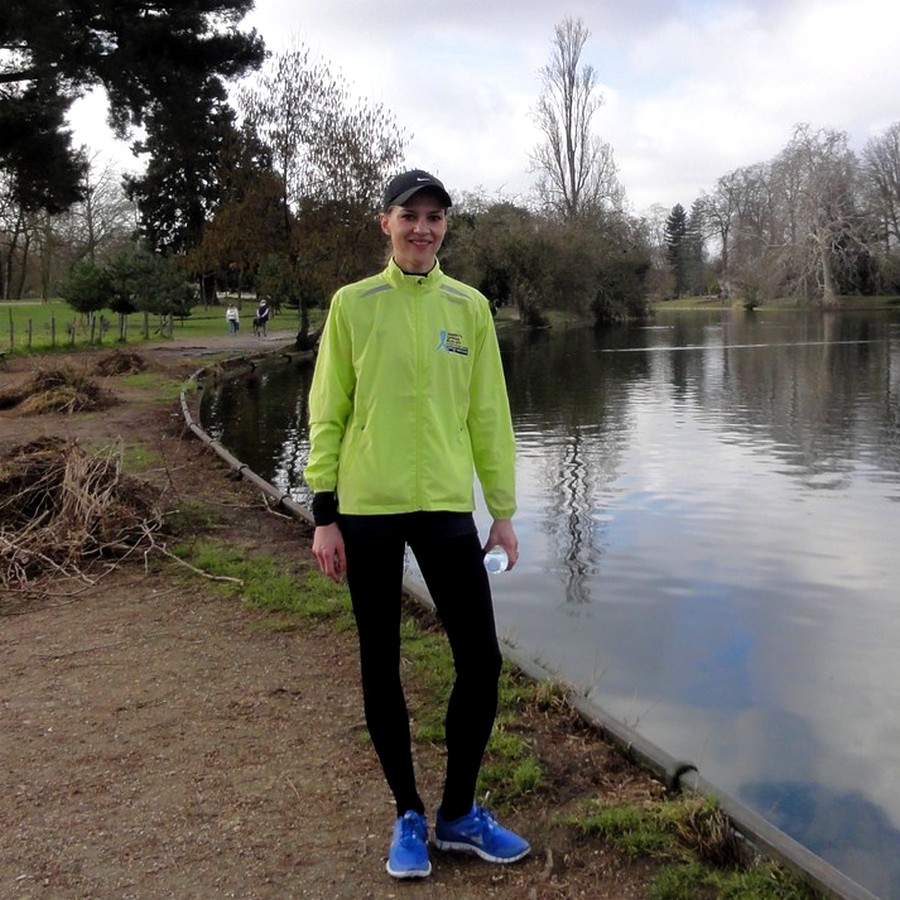
Magdalena – “Lac Inférieur” of the “Bois de Boulogne” – Close to Kilometer 41 (mile 25.8) 9:31 AM – Magdalena, who lives in Poland, prepares the 2013 Paris marathon. It will be her second marathon after the one of Warsaw. We thus chose to follow beautiful portions of the Paris Marathon route by running about 20 kilometers (12.7 miles). We joined at first the magnificent Wood of Boulogne, awaiting the arrival of spring. It is in this wood that are located the last six kilometers of the marathon. For example, very close to the big lake, is the kilometer 41, an important passage! Out of the wood, at the beginning of the avenue Foch, we reach the kilometer 42 of which you can see the track registered on the ground in the photo below (track of the 2012 Paris marathon – find the very fresh mark in this other article of April 2012). The 2013 road markings are soon going to appear… Magdalena – Avenue Foch – Kilomètre 42, à 195 mètres de l’arrivée ! Kilometer 42, only 195 meters to go, Rich in sensations and feelings… Before the “Arc de Triomphe”, is the “triumphant” arrival (we can see the location of the arrival on the photo above, at the green light – click on the picture for a larger view). We then stroll up the avenue Foch to find the Champs-Elysées, located on one of the branches of “the Star”, center of which is the Arc de Triomphe (“Place de l’Etoile”=”Place of the star”). The Paris Marathon starts in the middle of the Champs-Elysées. What a magnificent place to begin a marathon! (See a photo of the start in this other article.) Magdalena – Place de la Concorde – Having left the Kilometer 1 on the Champs-Elysées Champs-Elysées, “place de la Concorde”, the street of Rivoli, the Bastille, the Wood of Vincennes and its magnificent castle, the splendid banks of the Seine, the Wood of Boulogne and the grand finish avenue Foch. Aren’t you tempted by this route? Route of the 2013 Paris Marathon Merci Magdalena ! Good Paris marathon! The route of the tour :
In front of the garden of the Elysée with Meredith and John
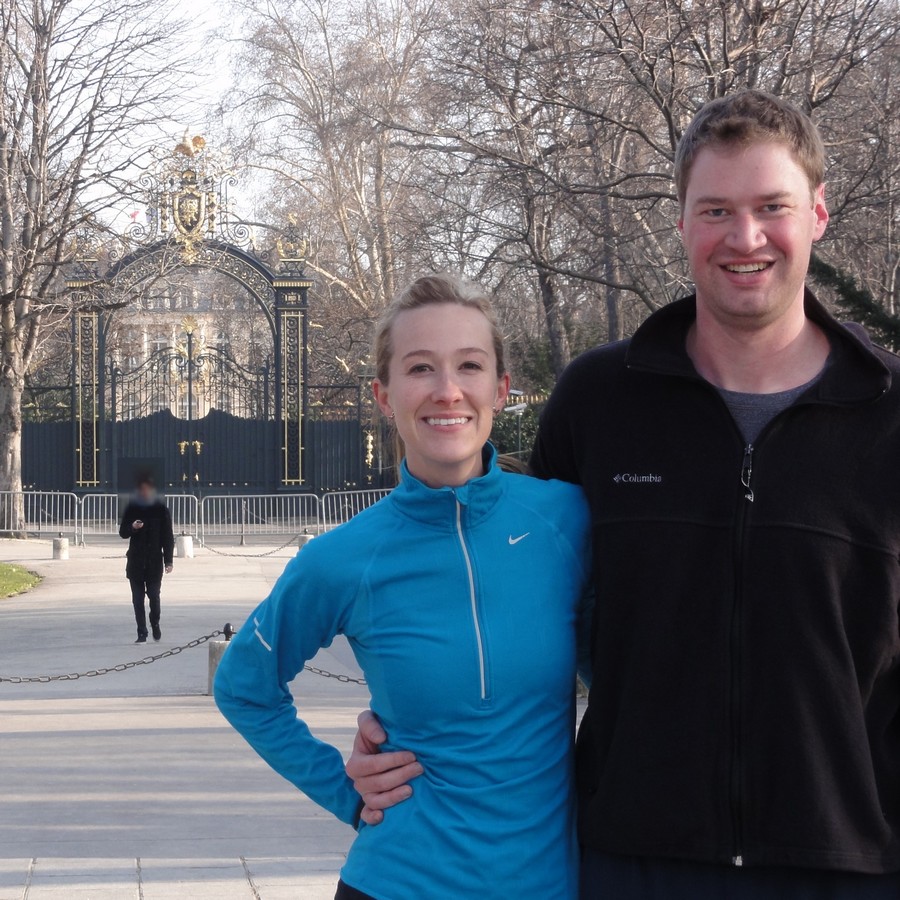
Meredith and John in front of the gardens of the Élysée Palace, residence of the President of the Republic. To see the main entrance, on the other side, you can click here 9:07 AM – Meredith and John come from the East coast of the United States (Washington, New York) and are in Paris for a cultural and very sports visit. This Monday, March 4th, we combined a tourist stroll and and “recovery jogging”. Indeed, Meredith ran the day before, the Paris half marathon by establishing a new personal record on the distance. Bravo Meredith! More than 30000 participants at the 2013 Paris Half-marathon! The start. With a close look, you will see 2 Paris Running Tour guides in the foreground, orange and (Paris Running Tour) green T-shirts That is thus, quietly, that we crossed Paris and took advantage of the beautiful morning, second brightened up morning after a very cold and dark winter. Meredith and John – Garden of the Tuileries – On the historical axis: far off the Obelisk of the place de la Concorde and the Arc of Triumph at the end of Champs-Elysées On the photo above, we see clearly the “pyramidion” (pyramid cover cap) at the top of the Obelisk, its gold cover shines as in the time of antique Egypt. Did you also know that the Obelisk of “Place de la Concorde” represented the gnomon (the needle) of a gigantic sundial? Had you noticed these marks on the ground? A gigantic sundial (1999) “place de la Concorde” – Click on the picture to see the details! The hour calculation is not as simple (duration of the day, etc.) By continuing our running, we returned on the historic axis, with in its beginning, the Louvre: Meredith and John – The pyramid of the Louvre It is in this way that we admired the oldest monument of Paris, the obelisk of Concorde (13è century BC) and one of the most modern, the Louvre Pyramid (inaugurated in 1989)! Merci Meredith, merci John! The route of the tour:
Running with Pedro and Juliana on the historic axis of Paris
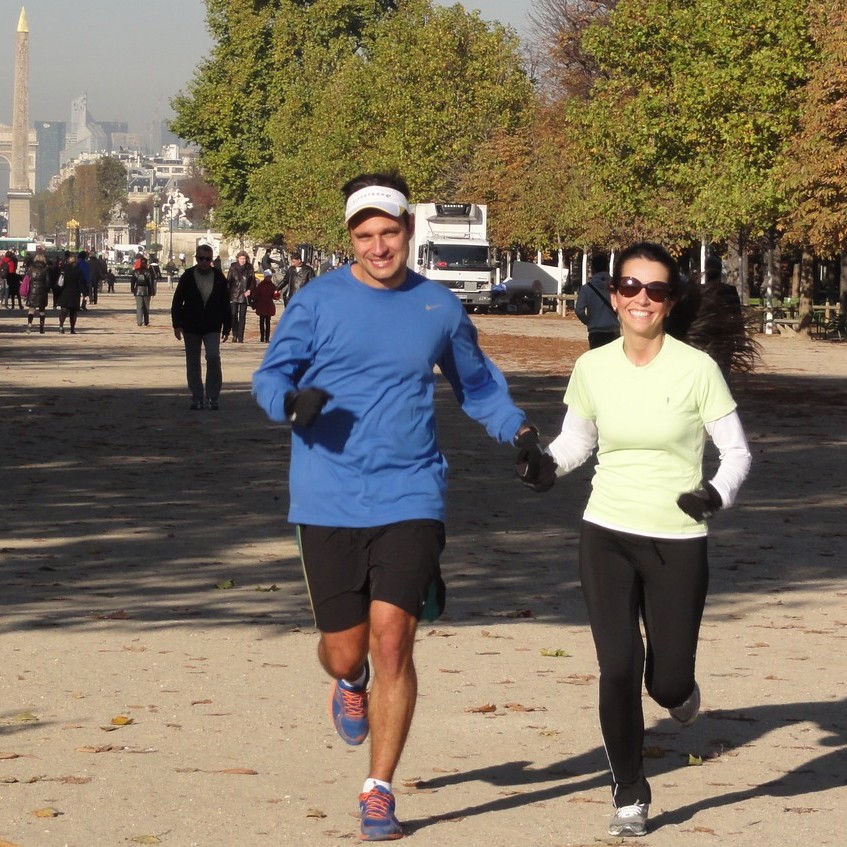
Pedro and Juliana – On the historic axis of Paris, in the garden of the Tuileries 9:10 AM – Juliana and Pedro are well trained runners from Campinas, near Sao Paulo in Brazil. We ran all along the river the Seine and for a good part, on the historic axis of Paris. Historic axis? Yes, it is the name given to the axis which leaves the center of Paris and goes westward. The history of this axis began when the Capetian kings took the habit to leave the Louvre to go hunting in the forest of Saint-Germain-en-Laye, drawing then a way in straight line to the West. In 1599, king Henri IV created a road on this axis leading of the Louvre to Saint Germain’s castle. This axis is successively fitted out and embellished, by the extension of the Louvre, the garden of the Tuileries, the place de la Concorde, the Champs-Elysées, the Arc de Triomphe and now, the Business center of the La Defense with the “Grande Arche”. Discover in detail the historic axis of Paris. Click on the following image. On the obtained page, you can again enlarge the image (a new click on it). Then, take place on the right of the image and with the horizontal-scroll, move on the left (Have a good trip!) Do you remember the previous article, which speaks about the Baron Haussman who had wished to enlarge the axis eastward? Do you also remember this running with Amy, where we had made a buckle on the West part of the axis by leaving from “La Defense”? Pedro and Juliana – Quai d’Orsay Juliana and Pedro – Champ de Mars and Esplanade du Trocadéro Merci Juliana et Pedro ! The route of the tour:
Place des Vosges with Anne and Niels
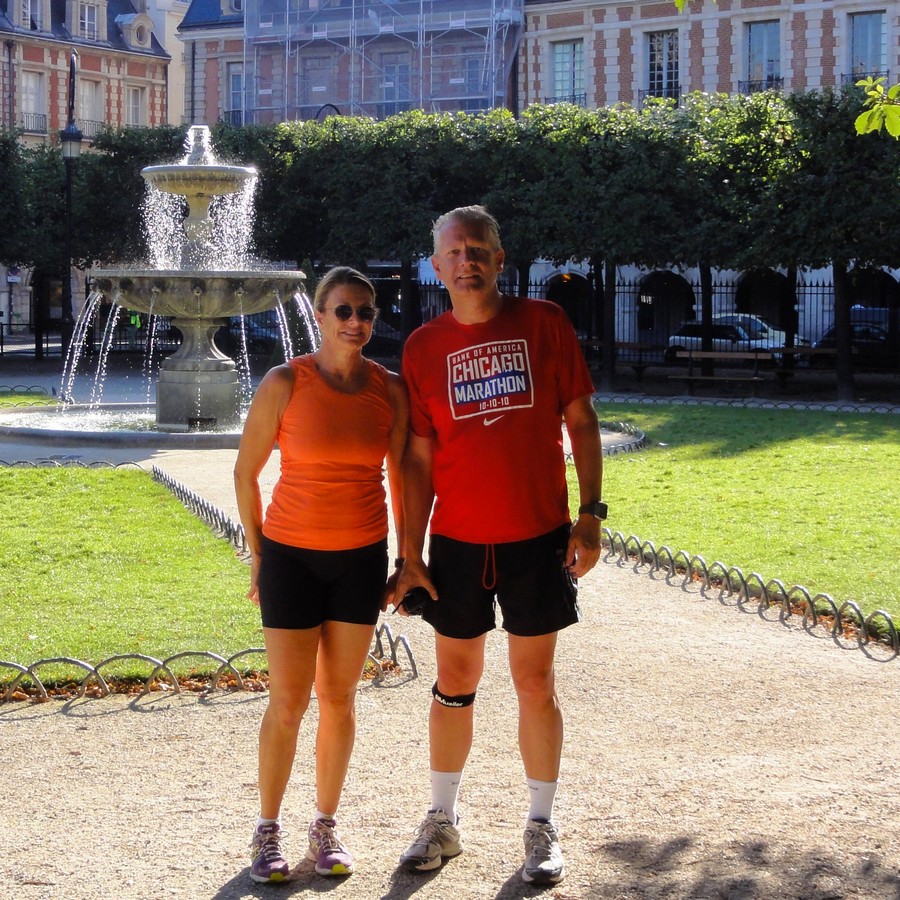
Anne et Niels – Place des Vosges 8:08 AM – It was a great pleasure to meet Anne and Niels from Denmark again. We had run together during a rather cold March, two tours in Paris, for the greater part on the left bank. This time, in this warm day of August, we chose the right bank and followed the plan of the ancient Paris surrounding wall of King Louis XIII, path which constitutes largely what we name “Les Grand boulevards”. To join the Grand boulevards, we went through some of the numerous covered passages of Paris, in particular the “passage des Panoramas”: Anne and Niels – Passage des Panoramas Deserted passage on a Sunday morning and thus usable by the runners! The passage of the Panoramas is one of oldest covered passages of Paris, created in 1799 and doubtless inspired by the oriental souks… The name “panoramas” comes because the main entry was framed by two towers where were exposed panoramic landscapes representing big cities, panoramas. On the Grand boulevards, we admired two big triumphal arches commissioned by king Louis XIV: the “Porte Saint-Martin” (1674) and the “Porte Saint-Denis” (1672). Both arcs were built to the glory of Louis XIV and of his victories and replaced the fortified doors become useless, Charles V’s wall being replaced by the Boulevard. Anne et Niels – Porte Saint Denis We then left the Boulevard to find the “Place des Vosges”: Anne et Niels – Place des Vosges Look closer at the Louis XIII’s statue. To replace the former bronze statue, melted during the Revolution, the sculptors chose the marble, indeed much heavier… The statue threatening to collapse in its center, it was decided to place a trunk under the horse’s belly. It gives a very strange look to this equipage, slowed down in its center by a tree trunk! Merci Anne et Niels ! The route of the tour :
Four mornings to explore Paris with Sarah
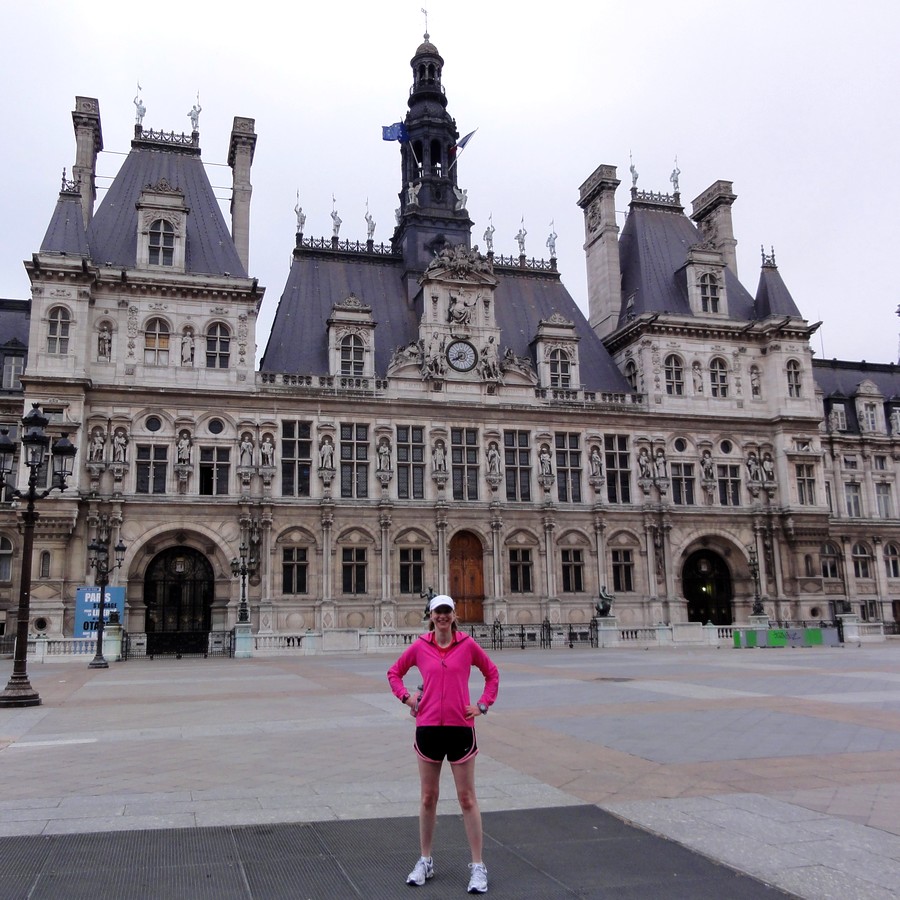
Sarah – Hôtel de Ville 6:30 AM – Sarah of Houston (USA), wished to discover Paris by running four following mornings with Paris Running Tour. It is thus with a big enthusiasm that we investigated the center of Paris as well right bank as left bank (see routes at the end of the post). Did you know that the metric system was set up during the Revolution? The National Convention (constitutional and legislative revolutionary assembly), to generalize the use of the metric system disposed sixteen marble standard meters at the most frequented places of Paris. These meters were installed between February, 1796 and December, 1797. With Sarah, during our explorations, we found both last ones which remain at present in Paris, the one of the right photo being the only one still on its original site: Standard meter Place Vendôme – Standard meter street of Vaugirard On the “grands boulevards”, we discovered two triumphal arches: Porte Saint-Martin – Porte Saint-Denis Yes, before the Arcs of Triumph wanted by Napoleon the 1st, place de l’Etoile and in the Carrousel of the Louvre, Louis XIV ordered the construction of these two Arcs in honor of his military victories (See the inscription at the top of the Arcs: “Ludovico Magno”, Louis the Great). Louis XIV, Sun King did not only make Versailles! The Arc of “La Porte Saint Denis” (“Porte”=door) and the Arc of “La Porte Saint-Martin” are in the location of former fortified doors of Paris, both belonging to the surrounding wall of king Charles V. Indeed, the “Grand boulevards” which we know now correspond to the ancient surrounding fortifications of Paris, built by Charles V, widened by Louis XIII, then destroyed under Louis XIV The word “Boulevard” comes moreover from the word “Bolevers” which comes itself from the ancient Dutch word “Bolewerk” meaning “Ramparts”. From the Charles V’s surrounding wall (1383) to the “nouveau Cours” (1705 ) – Representation of the door Saint-Martin See these trees planted all along the Boulevard. The Parisians called them “boules vertes” (Green balls). Boules vertes = Boulevards! Other origin of the word! Among our other historic explorations, we found the ancient Arenas of Lutetia (Lutetia = Paris before the third century later JC). They were accidentally discovered by chance during works in 1870. These Roman arenas could contain more than 10000 spectators. Under their eyes took place gladiators’ fights, fights of wildcats but also representations of comedies or dramas. Sarah – Arenas of Lutetia Nowadays, it is a quiet place for games of balls or tournaments of petanque. From time to time, theater companies play there. Merci Sarah ! The routes of the four tours:
At the Arc of Triumph with Tracy
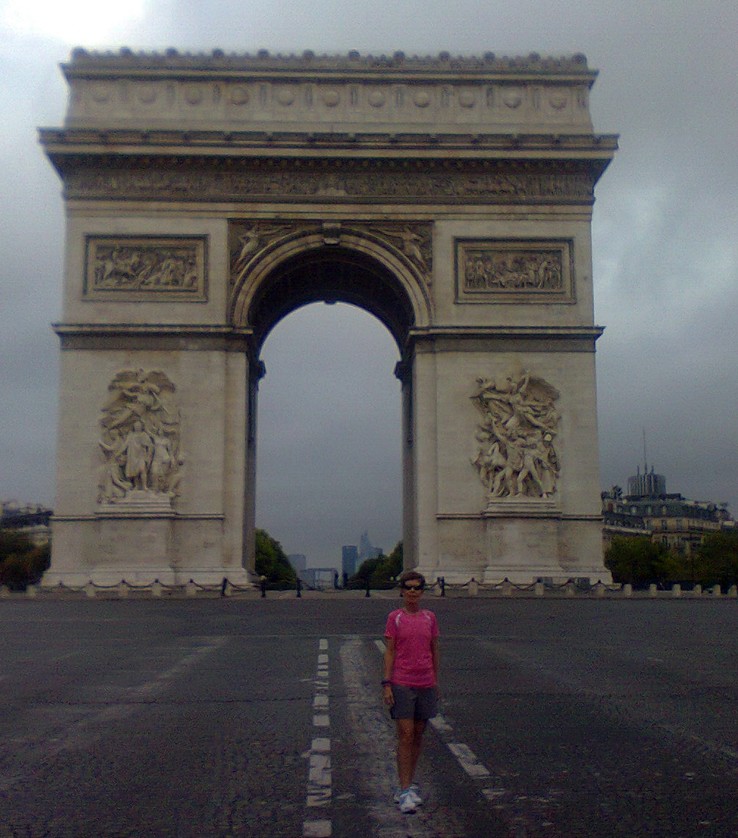
Tracy – Arc de Triomphe 6:30 AM – With Tracy, of Texas (USA), we ran the most beautiful Parisian Palace tour, admiring, during our running, the Ritz, place Vendome, hotel Meurice hotel, hotel of Crillon, the Plaza Athenée and other beautiful hotels. Of course, we did not forget the magnificent Parisian monuments such as the majestic Arc de Triomphe of which we took advantage quietly in this early hour. It is one of the arcs promised by Napoleon to his troops, as the one of the Carousel that we have already evoked here. Have you ever been at the top of the Arc de Triomphe? The sight on the avenues arranged in the shape of a star (star as the name of the place) is there magnificent. The Champs Elysées seen from the top of the Arc of Triumph, place de l’Etoile (place Charles de Gaulle) Merci Tracy ! The route of the tour :