
Running doing a spiral in the centre of Paris!
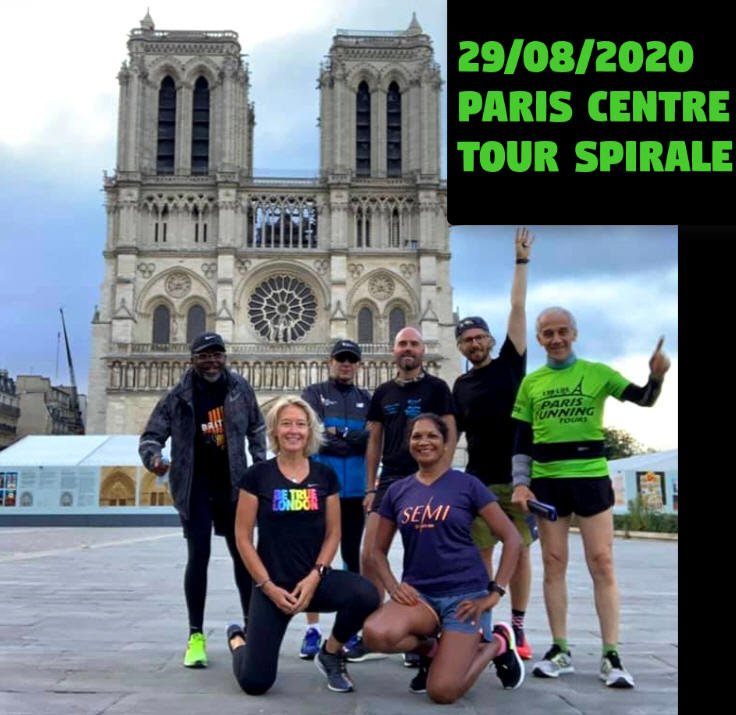
Running doing a spiral in the centre of Paris! So many things to discover or see again, to share the history of Paris, to understand the link between historical events and the physiognomy of the city, to have the joy of running together… a pleasant stroll (and the satisfaction of a shared drink in the beautiful garden of the Palais Royal after the effort…). Many thanks to Chrystelle, Eric, Flavien, Jérôme, Justice and Marie! Paris Running Tours: private tours or free outings, stay tuned! See you soon for new themed outings, we are full of ideas to show you around Paris 😀 If you too, you come to Paris, we will be very happy to run with you. Join us and discover Paris with authentic Parisians guides who will take you on the best sight running routes in Paris and who always have tons of secrets to share with you: Music: Vlad Gluschenko — Harmony License: CC BY 3.0: https://creativecommons.org/licenses/by/3.0/deed.en
A “mystery” running tour – discover our “drawing” run
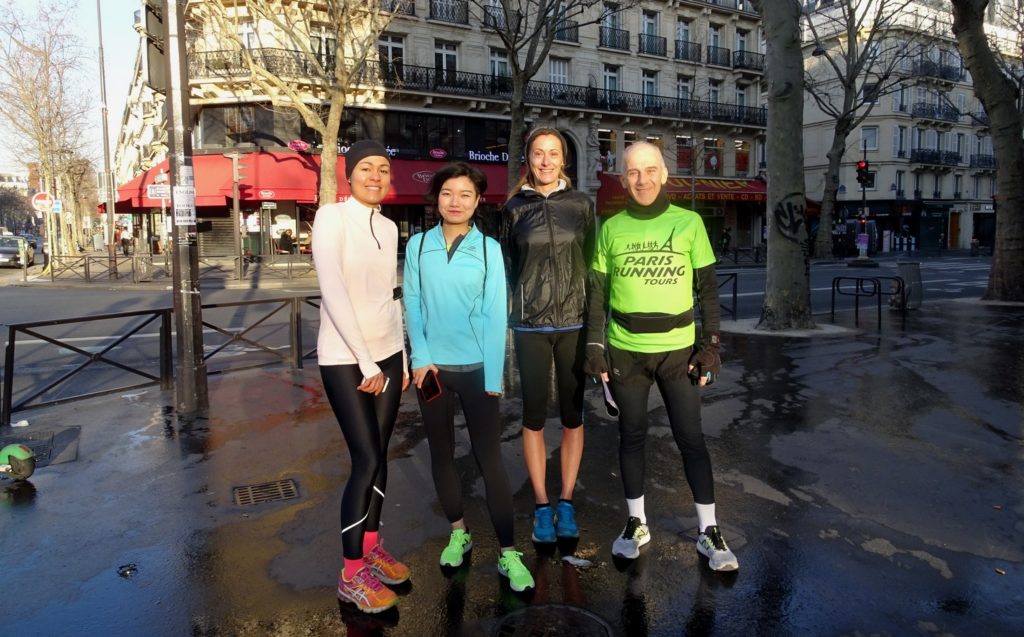
If you too, you come to Paris, we will be very happy to run with you. Join us and discover Paris with authentic Parisians guides who will take you on the best running routes in Paris and who always have tons of secrets to share with you:
Zigzags from Nation to Trocadero, 11 miles by running in Paris with Anne
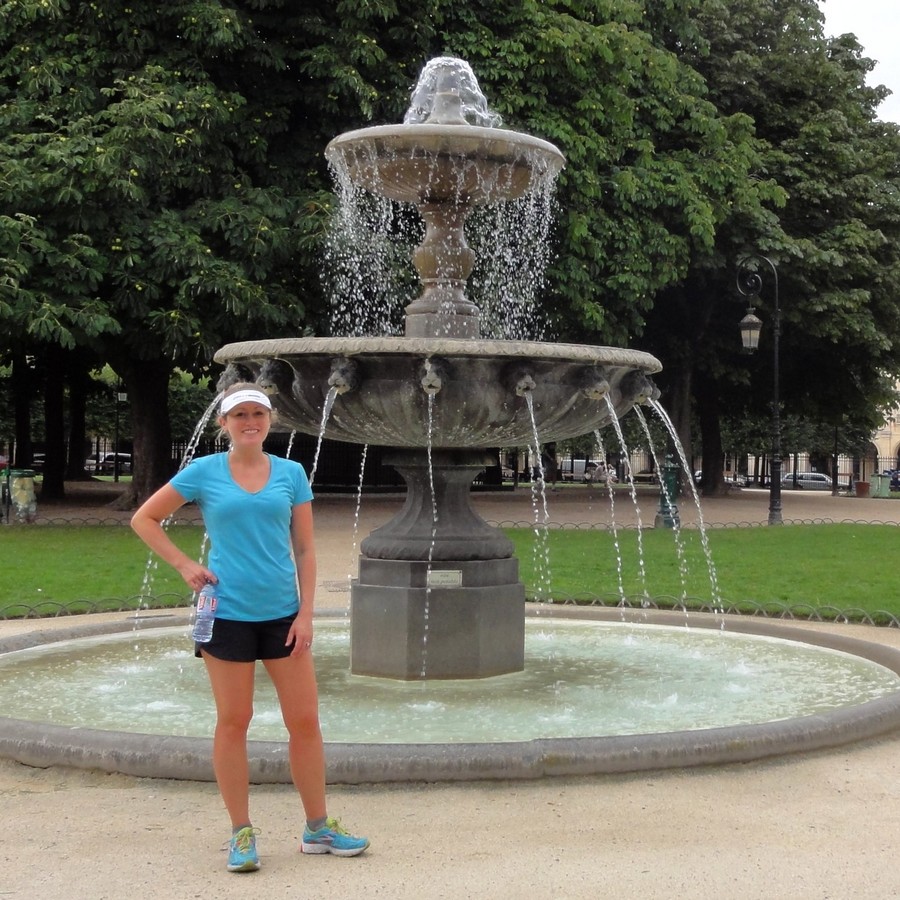
Anne – “Place des Vosges” 9:09 AM – Anne from Washington D.C. (USA) is a regular runner (look at her blog). In this first Monday of August, we had decided to cross Paris by running from east to west. We left a place near the square of “Nation” with the objective to reach “Palais de Chaillot” to take advantage of the beautiful view on the Eiffel Tower offered by the “Esplanade of the Trocadéro”. To go there by the shortest route? No, no, we chose to make a lot of zigzags to be able to appreciate Paris in all its magnificence. In the end, nearly 11 miles of an attractive tourist and sports route. First photo stop: the “Place des Vosges”. Very quiet this morning (photo above). Read here the funny short story of the statue of Louis XIII situated in the center of the garden. Did you know that this Royal place was renamed “Place des Vosges” because this department in the east of France was the first one to pay the tax during the Revolution? From “Place des Vosges”, to join the street Saint Antoine, we took the magnificent shortcut offered by the Hotel of Sully: Anne – “Hôtel de Sully” Still in the “Marais” (right bank), we are going to penetrate the Philippe Auguste’s Paris (by postern Saint-Paul). Indeed, king Philippe Auguste, at the end of the 12th century, before leaving for his third crusade, made build an important protective wall around Paris. Numerous parts of this surrounding wall are still visible nowadays. Below, the longest preserved portion of the wall. Discover here another massive part of the wall, left bank this time, as well as plans representing Paris of this time. Anne – Well of Phillippe Auguste – 12th century (Behind the wall, “Lycée” Charlemagne – High school) Let us cross the Seine to visit the Island of “La Cité”. Look (photo below) at the installations of “Paris-Plages” (Paris-beaches), right bank. Do you see the small red Eiffel Tower? We had spoken about it here and here. Anne – “Paris-Plages” Back right bank, surprise! A metro entrance (Palais-Royal station): Anne – “Métro Palais-Royal” (“Le kiosque des Noctambules” – Jean-Michel Othoniel) Compare this modern art subway entrance installed in 2000 with those created one hundred years earlier, representative of the “Art nouveau” movement: see here some examples of these metro entrances created in 1900. As a matter of fact, the other entrance of the same station, Palais-Royal, just in front of the Louvre, is typically “Art nouveau”. Zigzag, small detour on left bank, “Quai Anatole France”. Just in the opposite, the garden of the Tuileries which we are quickly going to join… Anne – “Quai Anatole France” …crossing the footbridge Léopold-Sédar-Senghor, which gives us a beautiful view on, from left to right, the Louvre, Notre-Dame and the Orsay museum: Anne – Footbridge Léopold-Sédar-Senghor In the garden of the Tuileries, here is a new example of modern art that we meet, a tree in bronze! Anne – “L’arbre des voyelles” (bronze molding installed in 1999 – Giusseppe Pepone) After other numerous discoveries, we finish our running as expected, Esplanade of the Trocadéro: Anne – “Esplanade du Trocadéro” Objective reached! Merci Anne ! The route of the tour :
In front of the rotunda of La Villette with Felicity
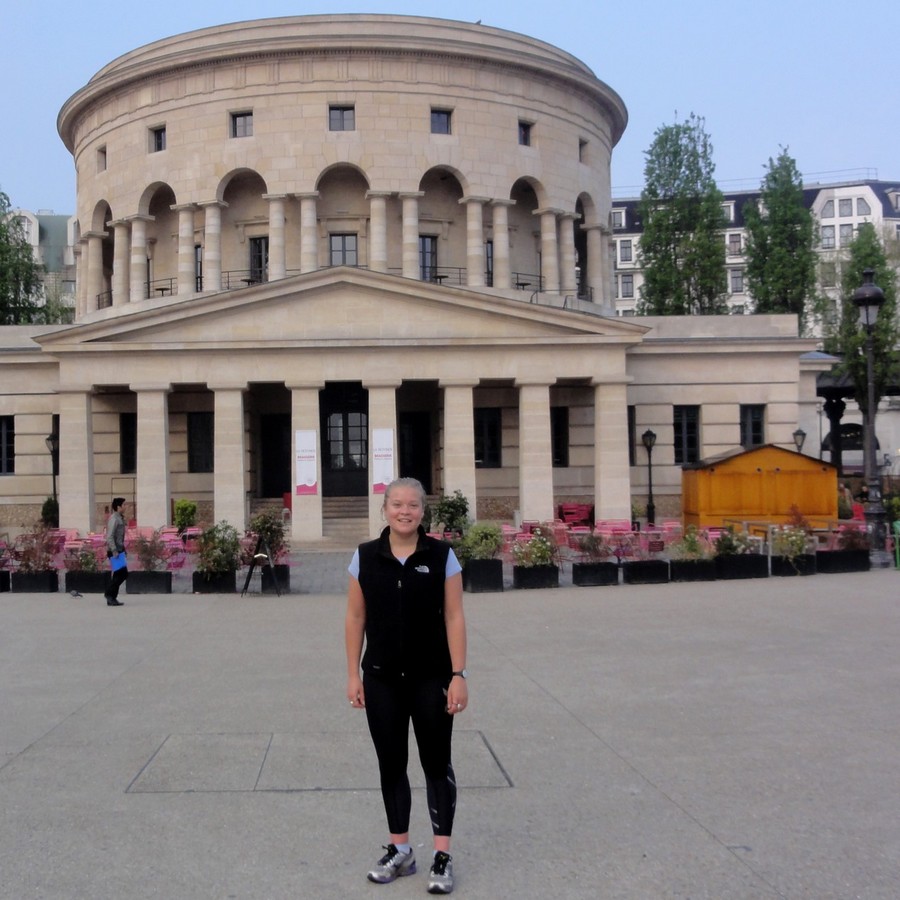
Felicity – Rotunda of la Villette 7:51 AM – Do you remember Felicity from Melbourne, Australia ? (See the post here.) Two years ago, we ran along the river Seine. This time, our route led us to the North East of Paris, since Montmartre up to the Ourcq canal, then to the Saint-Martin canal and to the Grand boulevards. First of all, we followed the former plan of the Wall of the Farmers Generals. Paris grew as an onion, protected successively by various surrounding walls (as for example, Philippe Auguste’s surrounding wall, see the post here). All these walls had a protective function except one: the Wall of the Farmers Generals. The different city walls of Paris The Wall of the Farmers Generals served to collect the tax on all the goods entering Paris (the “Octroi”). Its construction began before the Revolution in 1784, it was destroyed in 1860. At the time, we thus entered Paris by passages, barriers. Most of these barriers contained buildings called “bureaux d’octroi” (“offices of granting”). 61 “bureaux d’octroi” were created by the architect Nicolas Ledoux. There remains of these constructions among which the beautiful rotundas of the Parc Monceau and of the Villette. We can see the Rotunda of the Villette at the beginning of this article. We then followed the Saint-Martin canal, which construction was decided by Napoleon the 1st. Felicity – Saint-Martin Canal A little later, we joined the Grand boulevards and admired the Arc de Triomphe of the Saint-Denis gate, arc created by king Louis XIV, arc dedicated to the consecration of his glory (” Ludovico Magno “!). You will find the history of this Arc de Triomphe and the Grand boulevards in an article of the blog=> here. Felicity – “Porte Saint-Denis” Finally, back to Montmartre, we crossed the Moulin Rouge. Felicity – The “Moulin Rouge” Contrary to the “Moulin de la Galette” (see the picture here), the “Moulin Rouge” was never a real windmill, but from the beginning, a cabaret, this famous cabaret which saw the birth of the “French cancan” and which is always in service. Merci Felicity ! The route of the tour :
By running in the parks of Paris with Scott and Kelly
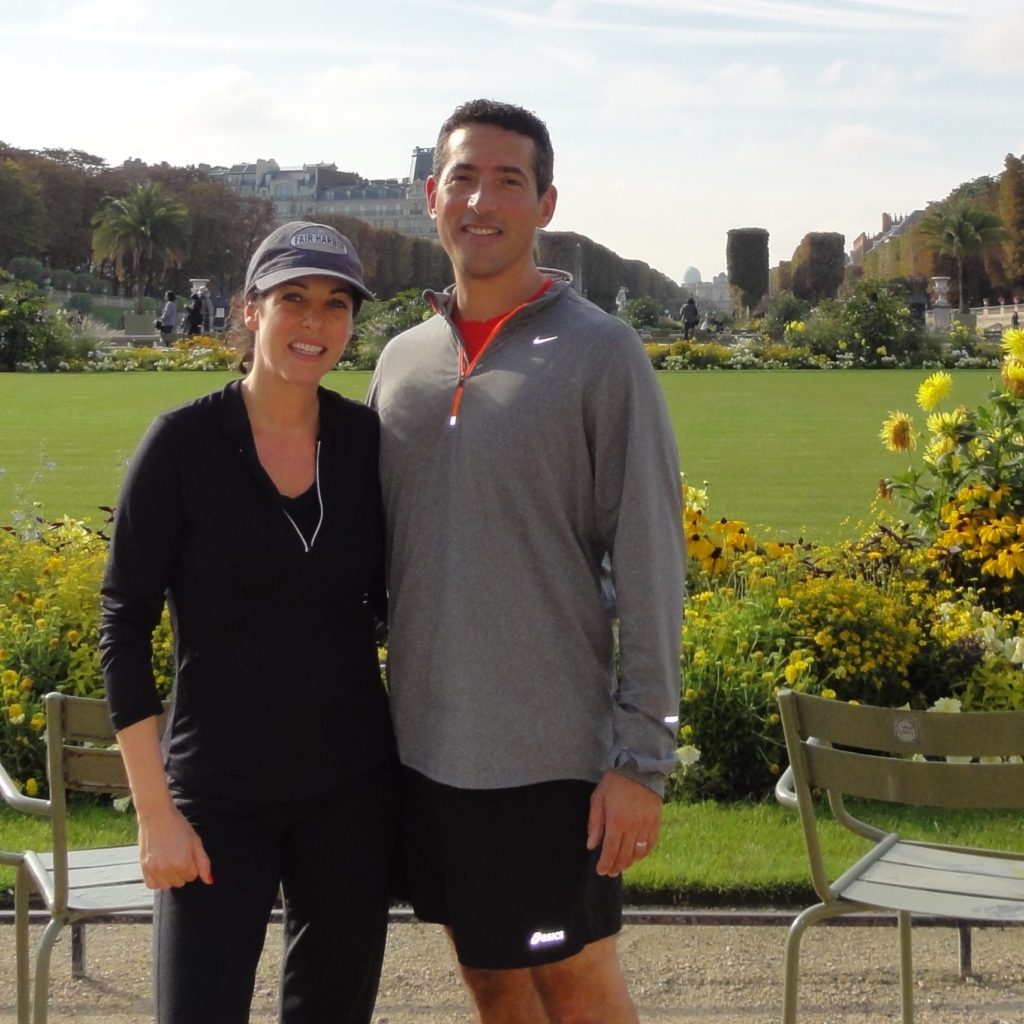
Kelly and Scott – Luxembourg gardens 8:59 AM – Kelly and Scott live in New York (USA) and usually run in the magnificent park of Central Park. Today, we discovered some of the superb parks of the center of Paris, the Luxembourg gardens, Tuileries gardens and the Palais Royal gardens. The name of “Luxembourg” for the gardens and the Palace (the current Senate) comes from the Duke of Luxembourg, François de Piney who possessed a hotel in this place, in the 16th century. Marie of Medici, the Regent of France, acquired the hotel and built the current Palace in 1615. Did you notice in the background of the above photo, a small dome far off? It is the Paris Observatory, the oldest observatory of the world still in function. It was created in 1667 by king Louis XIV. The Paris Observatory in the continuation of the Luxembourg gardens With the American “Center for Astrophysics”, it is the most important research center in astrophysics and in astronomy of the world. Very soon, the Observatory will open again its doors to the Public, from Thursday, 11 till Sunday, October 14th, 2012 on the occasion of the “fête de la Science“. Of the three parks, which is the most beautiful one? The Garden of the Luxembourg, the discreet Garden of the Palais Royal, or the Garden of the Tuileries, placed on the historic axis of Paris? Impossible to say, they are splendid all three! Let us find the Garden of the Tuileries, a good place to run: Scott and Kelly – the Tuileries gardens and the small garden of the “Palais Royal”, well isolated by the “Palais Royal” palace and the adjacent Galleries: Scott and Kelly – Garden of the Palais Royal On our road, when we discovered a part of Philippe Auguste’s outer wall, a nice runner proposed to take a picture of us: Paris Running Tour, Scott, Kelly – Philippe Auguste’s outer wall (13th century) Thanks to him. A good souvenir! Good runs in Central Park then! Merci Kelly ! Merci Scott ! The route of the tour :
Ancient Paris, modern Paris with Beth, Paige and Pamela
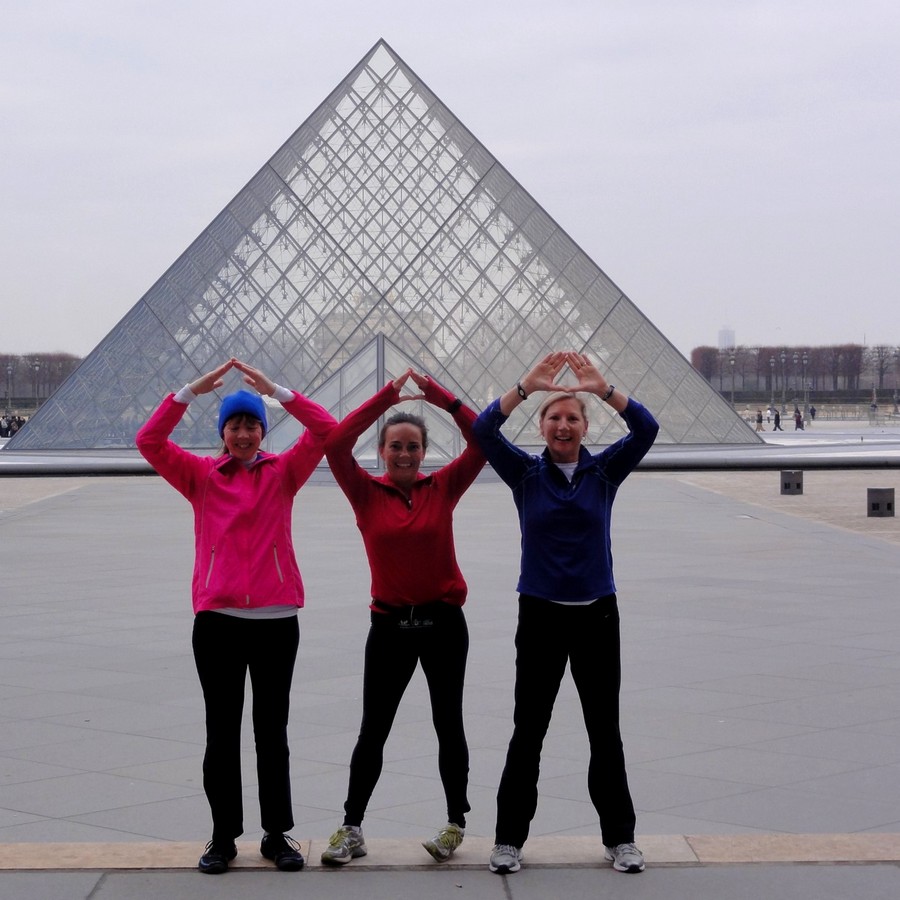
Pamela, Beth, Paige – Bridge of “la Concorde” and “Assemblée Nationale” 8:15 AM – With Beth, Paige and Pamela from North Carolina (USA), we discovered by running the variety of the Parisian landscapes, from the most ancient parts of the city to the most modern Paris: 19th century. We left the “Place de la République” and followed the “boulevard du Temple”, formerly named the “boulevard of the Crime”. This ancient nickname is due to the theaters which populated the boulevard in 19th century, numerous “crimes” were committed but only in the melodramas which occurred there! A place very livened up in the time, remember the beginning of the movie “The children of the paradise” which redraws so well that had to be the Boulevard: 12th century. We then joined “Le Marais” and crossed the most visible part of the surrounding wall of the king Philippe Auguste then admired Notre-Dame. The surrounding wall and the Cathedral which made us return to the end of the 12th century: Wall of Philippe Auguste – Creation 1190 | Cathedral Notre-Dame of Paris – Creation 1163 20th century. After the Middle Ages, it is the end of the 20th century which appeared, at first with the Louvre Pyramid, created by the architect Ieoh Ming Pei in 1989, then with the “Kiosque des Noctambules”, metro entrance (Palais-Royal station) and work of art created in 2000 by the artist Jean-Michel Othoniel: Louvre pyramid – Inauguration 1989 | “Le kiosque des Noctambules” – Installation 2000 Paris always evolves; what will the 21st century give us? Merci Beth, merci Paige, merci Pamela! The route of the tour:
Two mornings in the discovery of Paris with Jason
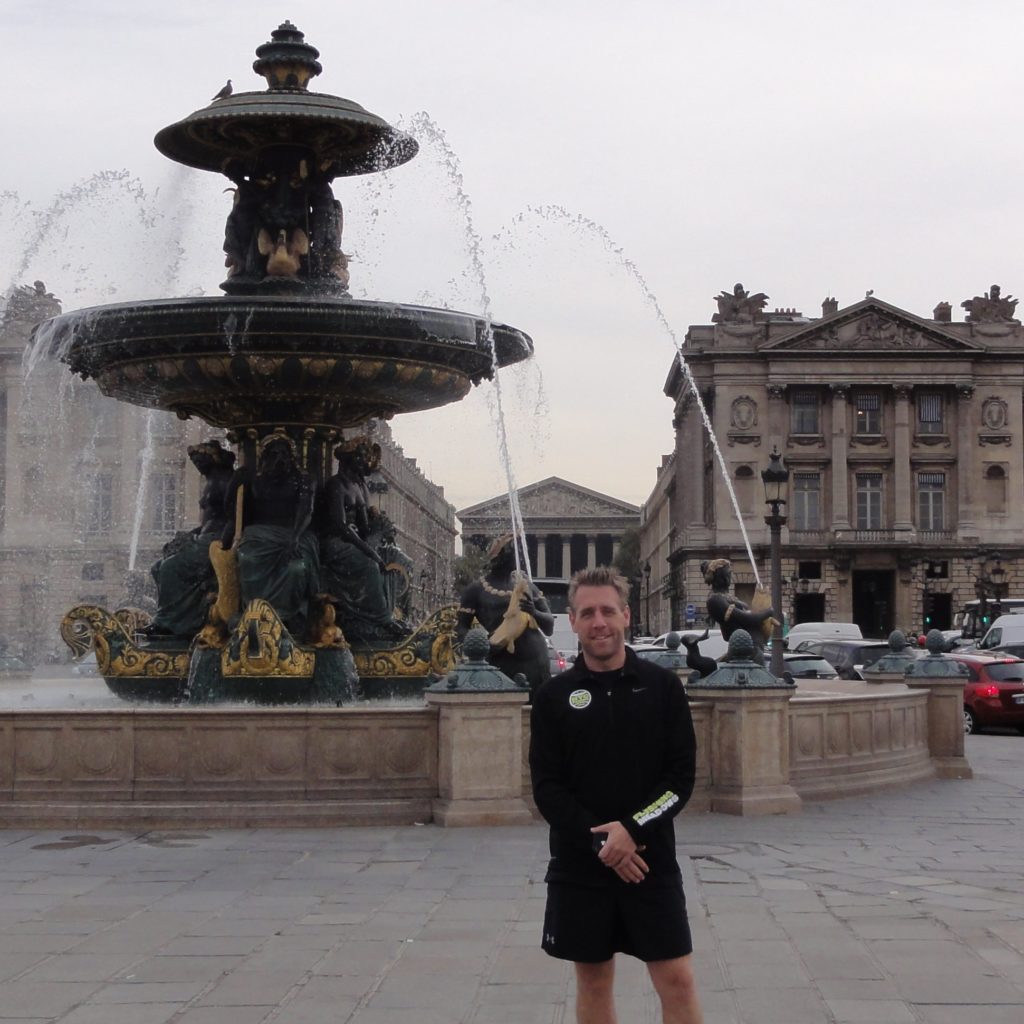
Jason – Place de la Concorde 8:50 AM – Friday and Saturday – Jason, who lives in Brooklyn (NY – USA), chose to discover Paris by running two following mornings. The first day, we explored the island of La Cité, the Louvre, the Palais-Royal, the place Vendôme, the place de la Concorde to return along the Seine. We finished our running in the Arenas of Lutetia; gladiators fought there when Paris was a part of the Roman Empire. The next day, we ran Left bank, crossed by the Pantheon, the garden of the Luxembourg, crossed the residence of the Prime Minister: Matignon, admired the Rodin museum since the street, and joined then the Invalides and the Eiffel Tower then returned by the boulevard Saint Germain. Jason and a well-known tower in Paris Our route brought us to cross the limits of Paris in the Middle Ages, the Louvre which was a fort intended to protect the western edge of the city and the surrounding wall of king Philippe Auguste some vestiges of which there are still in the current Paris, as the wall that we can see street Clovis (5th arrondissement): In the 12th century, Paris represented a small portion of the present Paris, surrounded by Philippe Auguste’s wall (in yellow on the image) and protected by the Louvre, a fort in the time (in blue): Click on the image to enlarge it By getting closer, we can see some places where we can find the old and still visible wall nowadays: Click on the image to enlarge it Merci Jason ! The routes of the tours: